



Ask somebody to pick a random number and they may pause for a moment, look upwards and choose 7. Ask them to pick six lottery numbers and they may avoid consecutive values, create a pleasant balance and include a birthday.
These habits aren't foolish. They show that human beings are excellent at giving randomness a story, even when the official drawing has no interest in that story at all.
We like randomness that looks carefully arranged
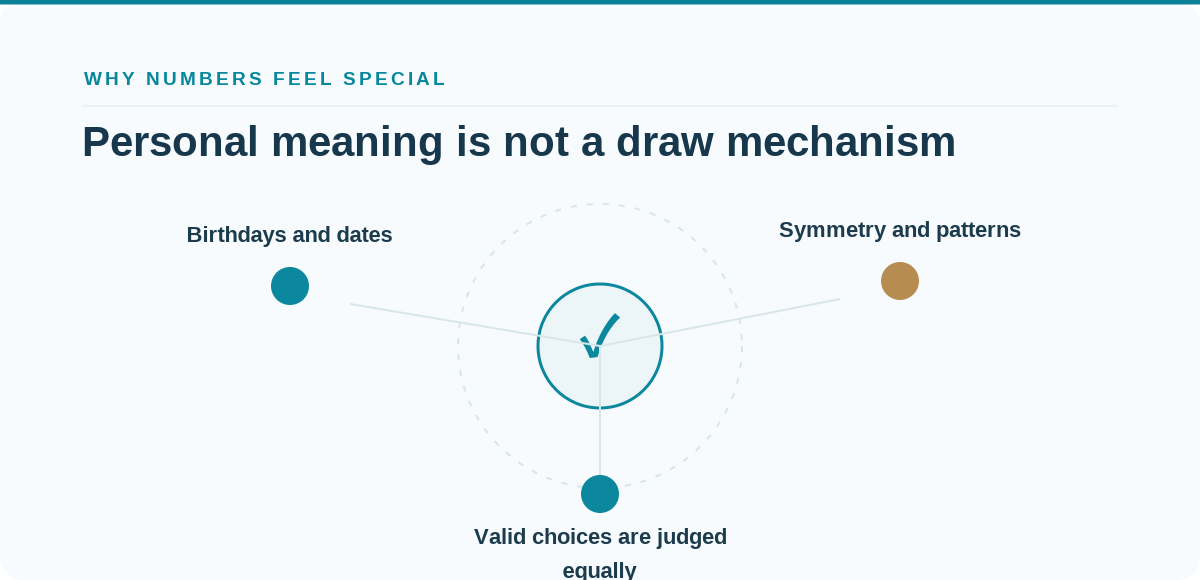
A line with numbers scattered across the whole range feels more convincing than six consecutive values. But every specific valid unordered combination is equally likely under a fair game model.
One unusual-looking combination may belong to a rarer type of combination, such as exact six-number runs, but that does not make the particular line less likely than another particular line. Confusing the odds of a category with the odds of one member of the category is a surprisingly persistent mistake.

Familiar numbers feel more controllable
Birthdays, anniversaries and addresses are easy to remember. Choosing them creates a personal connection that Quick Pick does not. But the resulting line is not strengthened by that meaning.
Players may also feel that changing a long-used set would be a mistake because the old numbers might finally appear. That is a powerful emotional story with no basis in the independence of fair future draws.
We notice wins more than misses
A dream that matches a winning number may become a family legend. All the dreams that did not match anything disappear from memory. Successful coincidences are memorable precisely because they are unusual.
This selective attention can make rituals seem more effective than they are. A proper evaluation would preserve every prediction, including failures, and compare outcomes against an appropriate chance baseline.
A useful experiment with friends
Ask several friends to write six “random” numbers from 1 to 59 without consulting one another. Then compare how many people used dates, obvious sequences or similar ranges. You may find shared human habits even without any deliberate coordination.
Now compare those lines with output from a documented uniform generator. The purpose is not to discover which group has a better chance of winning; each specific valid line still has the same probability.
Instead, the exercise reveals how our minds try to produce a convincing picture of randomness. That is a valuable lesson about judgment, design and statistics, entirely without buying a lottery ticket.
How interfaces shape our choices
A generator that always displays sorted numbers can make the output appear tidy, even though the selection process was random. Filters that promise balanced numbers may appeal to our aesthetic preferences, not to the mathematics of winning.
Design can help users feel comfortable, but it should make clear when a preference changes the generator's output distribution.
Why “almost winning” feels so important
A ticket that comes close to a prize can create an emotional response far larger than an ordinary loss. The numbers seem to have nearly aligned, inviting the thought that a small adjustment or another attempt might finish the job.
But a near miss is a result, not a message from the next draw. It does not establish that your chosen numbers are approaching a winning state. The official draw has no memory of how disappointed or hopeful you felt.
Understanding that bias can be useful beyond lotteries. People often see meaningful progress in random sequences, particularly when an outcome carries emotional or financial significance.
A sound number-selection tool should not exploit that feeling by suggesting a near miss proves that a secret method is close to succeeding.
The pattern we are likely to notice
A pair of consecutive numbers in a draw can feel meaningful because it is easy to describe and remember. A completely irregular combination might be forgotten within an hour. The more memorable results get repeated in conversation, which can make patterns seem more frequent than they are. That is a feature of human attention, not evidence that the random mechanism has changed.
Make the psychology useful
Recognising these biases can help you enjoy lottery choices without assigning them false significance. Choose personal numbers if you like. Use an unrestricted generator if you prefer convenience. Avoid spending more because a feeling of certainty appears.
LottoLuma's guide and methodology explain the available selection approaches, while the responsible-play page keeps the entertainment context visible.
The human mind is wired to find meaning. You don't have to stop enjoying that talent — only stop asking random balls to agree with it.
Sources and further reading
- LottoLuma — FAQ and number selection methods
- LottoLuma — methods, sources and limitations
- LottoLuma — safer lottery participation
Reference links support the article's factual and technical framework. Verify the current game version and editorial wording again before publication.