


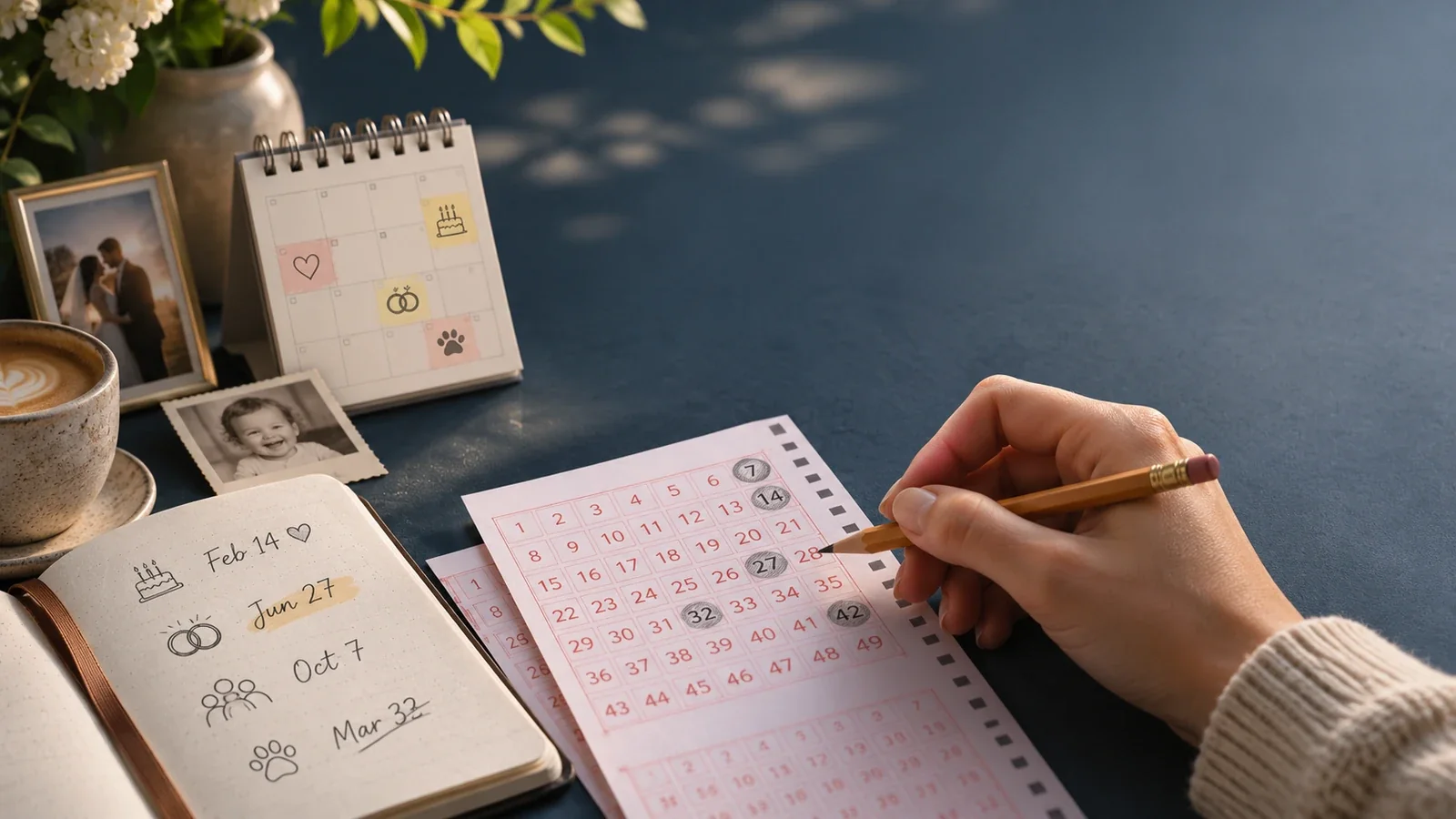
Nearly everyone has a number that means something. It might be a birthday, a football shirt number, a memorable house number or simply the one you choose when somebody asks you to pick a number between one and ten.
You can build a valid lottery line around that preference. A lucky number can make the line more personal, but it cannot change the probabilities of a fair draw.
First check whether your number belongs in the pool
Suppose your favourite number is 64. It cannot appear as a main number in UK Lotto's one-to-59 selection range. A generator should tell you that instead of quietly squeezing the number into a game that does not permit it.
The issue becomes more interesting with multi-pool games. A number can be within the main-ball range but outside the separate bonus-ball range. For EuroMillions, Lucky Stars are chosen from 1 to 12; it does not make sense to put a cherished number 27 into the Lucky Star slots.
Rules come first, then preference.

Lock a favourite and select the rest
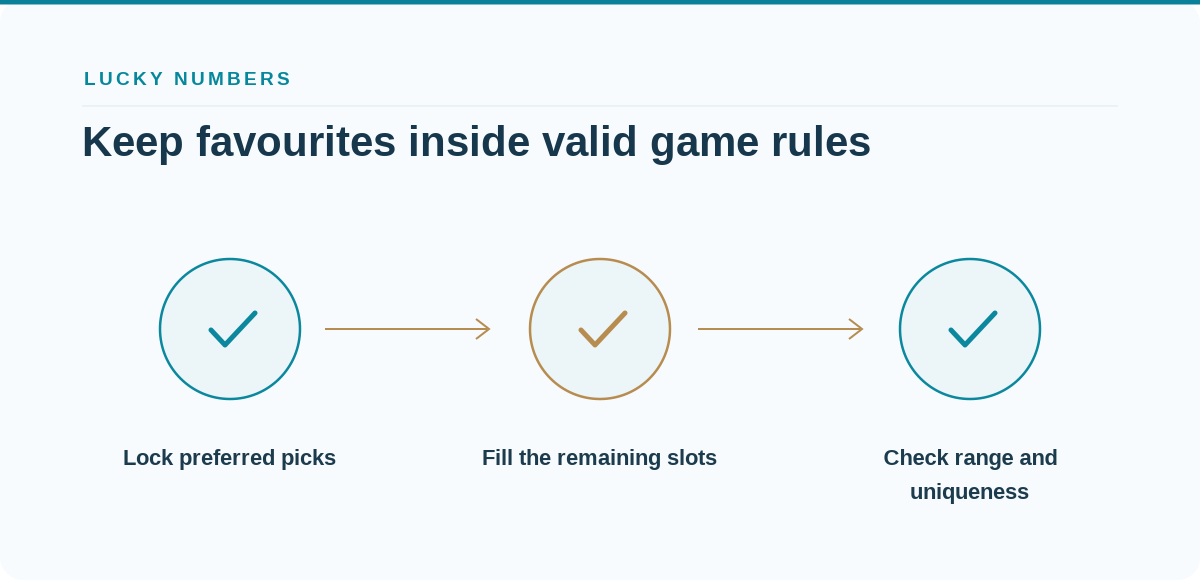
A practical way to include a favourite number is to hold it fixed and create the remaining valid positions from the permitted pool. If the game requires six different numbers, locking one leaves five additional distinct main numbers to choose.
Do not let the tool duplicate your locked value in the remaining positions. Likewise, if you lock several values, check for duplicates or out-of-range inputs before generating.
If a particular LottoLuma game studio does not offer the exact locking behaviour you want, you can still select the favourite manually and use a suitable general number-range tool for an example. Verify the final combined line against the actual game format.
When a personal number conflicts with a selection rule
Imagine wanting to use the number 60 in a game that permits main numbers only up to 59. A trustworthy generator should reject it or clearly explain the problem. Reducing it to 59 without warning would silently change the user's request.
The same principle applies to repeated favourite numbers. If a standard game needs distinct main values, a user's two identical locked numbers cannot occupy two different positions in a valid line.
A clear interface should present the error before generation and allow the user to choose another valid value. It should not produce an invalid result for the sake of making the screen look complete.
That is an example of personalisation improving usability without making any mathematical claim about winning chances.
Birthdays create a distinctive pattern
Dates tend to draw people towards numbers 1 through 31, and months concentrate attention on 1 through 12. That may make birthday-based selections less representative of the entire available main-number range.
It does not make them less likely to win as exact combinations. But in games with shared jackpots, popular selections may sometimes be relevant to prize sharing if the combination wins. There is no guarantee that any particular birthday line is shared or unique.
A lucky-number method that stays mathematically honest
Choose one favourite number and write it in the first available position of an example line. Check it is within the permitted range. For a standard game that requires distinct main numbers, draw the remaining numbers from the other permitted values, not from a pool that might select the favourite again.
Now try the opposite exercise: generate the entire line without preferences. Put the two results side by side. Which do you like more? That is a meaningful personal question. Which exact line is more likely to be drawn? Under the fair lottery model, neither.
If a birthday number exceeds a game's maximum special-ball range, don't force it into the wrong pool. You can use a different meaningful number, choose another game for the exercise, or simply leave the special-ball selection random.
The result should be a valid combination that you can identify and understand, not a story about having discovered a route around chance.
The birthday-number limit
If you use birthdays as your source, your familiar choices tend to fall between 1 and 31. In a game where the main pool extends to 59, that habit leaves many legal numbers unused by your personal method. It does not make the selected birthday line less likely than another *specific* combination, but it does mean your preferences are not sampling the entire pool uniformly.
Keep the ritual enjoyable, not compulsory
A favourite number is a harmless personal detail until it starts to feel like a rule you must obey to avoid bad luck. The official draw neither notices nor rewards loyalty to that number.
If you are using a generator to explore combinations, don't let a feeling of being “due” turn into repeated paid entries. Keep any participation within a comfortable entertainment budget.
Use LottoLuma's game directory to choose the correct format and its random-number generator to explore number sets. The strongest use of a lucky number is simply to make your selection feel like yours.
Sources and further reading
Reference links support the article's factual and technical framework. Verify the current game version and editorial wording again before publication.