


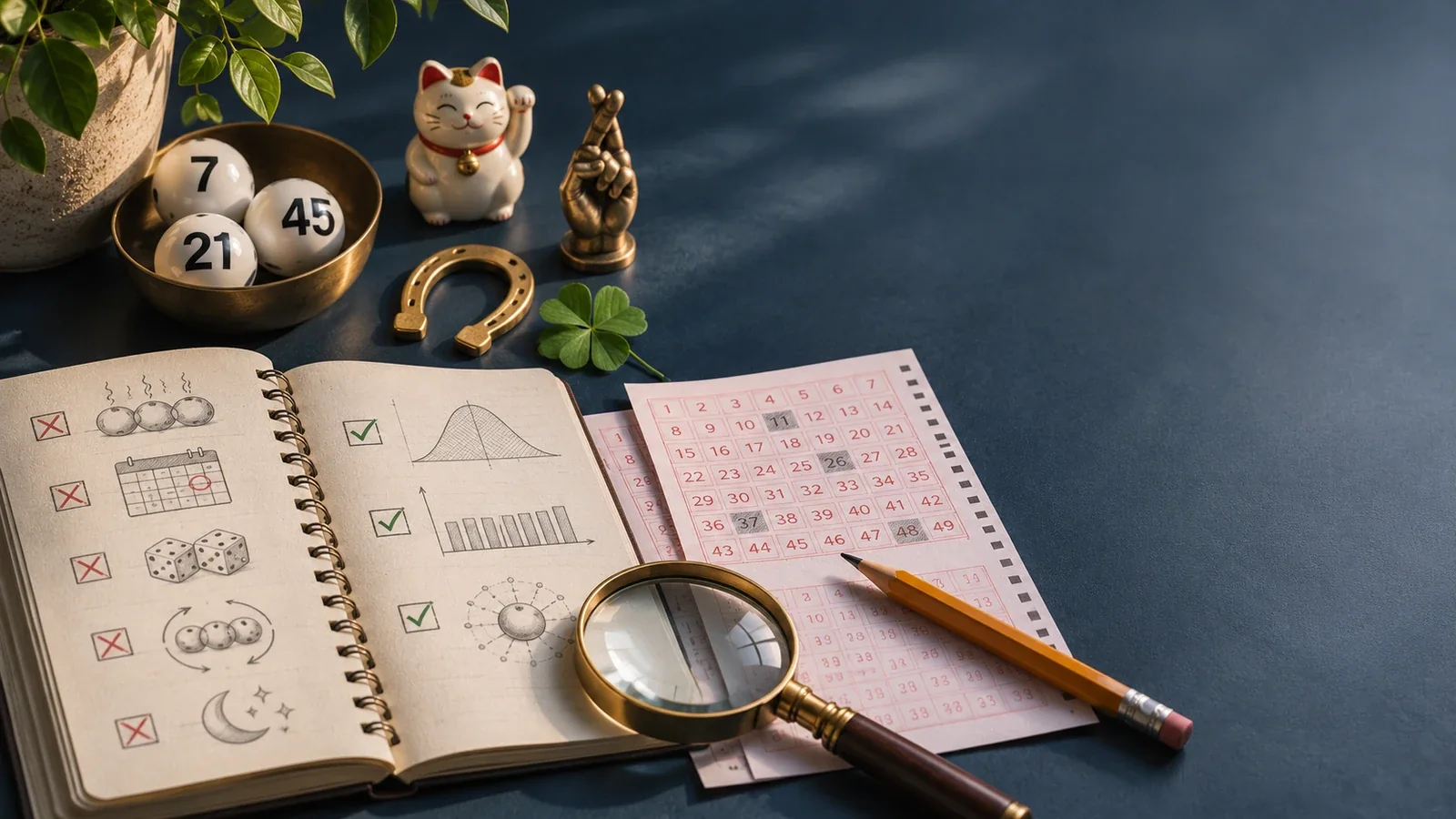
Picture someone sitting at the kitchen table, writing the same six numbers in a notebook every evening. They visualise a winning ticket, imagine the moment they hear the announcement and feel that the repetition brings the result closer.
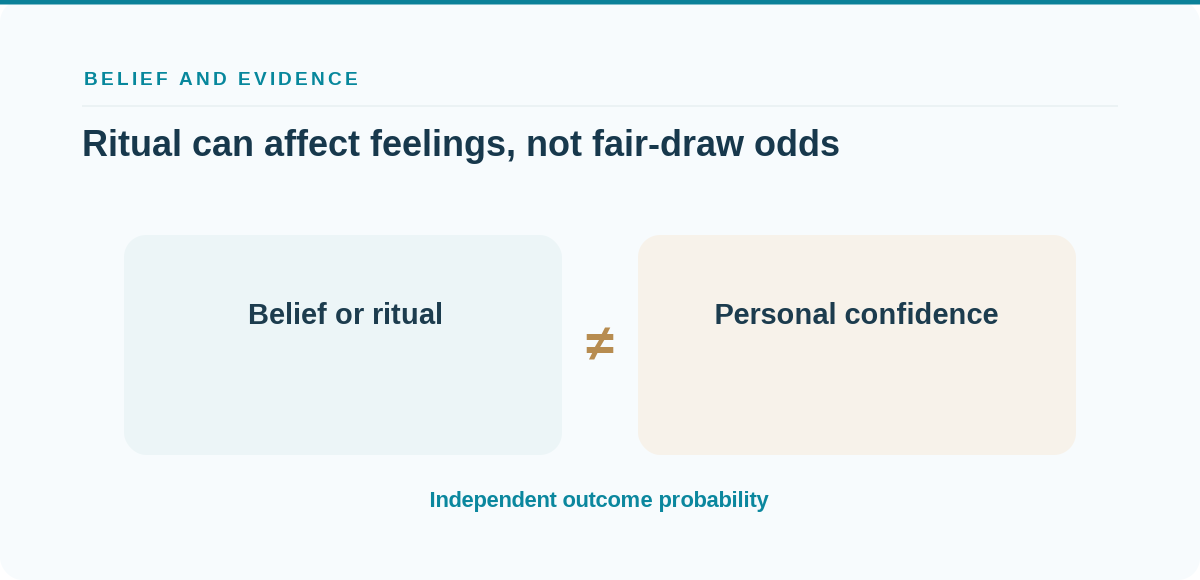
That practice can have personal meaning. But there is no demonstrated mechanism by which visualisation or manifestation changes the probability of numbers appearing in a properly conducted lottery draw.
A ritual and a prediction are not the same thing
Manifestation is often presented as concentrating on a desired outcome until it happens. The difficulty with applying it to lotteries is that the draw does not respond to an individual's intentions, enthusiasm or certainty.
If six distinct numbers are selected from 59 in one fair round, a given combination has one chance in 45,057,474. Thinking about that combination repeatedly does not alter the ball pool, change the draw equipment or remove competing combinations.
The personal experience may change; the mathematics does not.
Why memorable successes make the belief feel convincing
People naturally remember coincidences that feel extraordinary. If somebody dreams about a number and it appears in a draw, the story travels. The many dreams that did not align with results are far less interesting and rarely become social-media posts.
This is a form of selection bias. We hear disproportionately about the dramatic matches, not the full collection of predictions and missed guesses. Without that denominator, even an authentic anecdote tells us little about whether a method works.
There is also hindsight: after seeing a result, vague dreams or symbols can be interpreted to fit it. A reliable prediction would need to be precise, recorded beforehand and evaluated against a clear chance baseline.
Does believing strongly make an outcome less random?
No. A person's conviction is internal; the draw is an external event governed by its equipment, software and rules. The two do not become causally connected simply because the belief is powerful.
A believer may feel that visualising a particular line helps them focus, stay hopeful or enjoy a harmless ritual. Those experiences are real as experiences. They should not be converted into numerical claims about winning chances without evidence.
A useful comparison is to write down a dream-based selection and a separately generated random selection, then examine both under the same game probability model. The exact-match chance for each valid line is the same.
That exercise respects people's interest in symbols while keeping the claims about lotteries scientifically grounded.
Can visualisation still have a harmless role?
People use rituals for many reasons: comfort, celebration, playfulness or a sense of occasion. A lottery-related ritual can remain just that, provided it is not sold as evidence of a guaranteed result or used to justify spending more than intended.
If imagining a win is an enjoyable part of a conversation with friends, it need not be treated as a scientific hypothesis. Problems arise when someone is persuaded that financial hardship can be solved by buying more tickets while thinking more positively.
A healthier way to interpret a near miss
Suppose you visualise six numbers and the official result matches four of them. The coincidence may feel intensely personal, especially if you had thought about the line repeatedly. But there are many possible partial-match events, and their probabilities differ from an exact jackpot match.
The temptation is to treat the near miss as proof that your technique is “almost working” and therefore worth a larger purchase next time. That reasoning is dangerous. A near miss is an outcome of the game, not evidence that an independent drawing has begun responding to your intentions.
If you enjoy dreams or symbols as creative prompts, you can use them to generate imaginary lines without buying any ticket. That preserves the entertainment element while avoiding a financial decision based on an unsupported causal claim.
Positive thinking may be valuable in many aspects of life. It is not a reliable method of changing random lottery results, and it should never be sold as a solution to money problems.
A boundary between ritual and prediction
A lucky ritual may make a routine feel meaningful, just as a favourite song can become part of a morning. The ritual is not a controllable input to a separately audited random draw. The distinction matters most when someone is encouraged to spend money because a feeling, vision or manifestation supposedly guarantees a win. No such guarantee follows from the mathematics.
An experiment you can do without buying a ticket
Write down one predicted six-number combination for each of a set of future draws, time-stamp the records and compare them with the eventual official outcomes. Keep every failed prediction in the record. You can do this purely as a thought experiment or statistical exercise without entering any lottery.
If you want to understand how rare exact jackpot matches are, LottoLuma's odds calculator makes the underlying combinatorics easier to explore.
The fairest conclusion is that imagination can influence how people feel about numbers, but not the behaviour of an independent fair lottery machine. Enjoy a ritual if you wish; don't mistake it for a promise.
Sources and further reading
Reference links support the article's factual and technical framework. Verify the current game version and editorial wording again before publication.