



Search for a free lottery number generator and you will find everything from a single bright button to elaborate dashboards claiming artificial intelligence can discover the next jackpot. The first tool might be useful. The second might be dressed up to look more scientific than it really is.
Price is not the test. A reliable free generator should create valid selections, explain its method and be honest about what it cannot do. The rest is largely a question of convenience.
The first test is remarkably ordinary
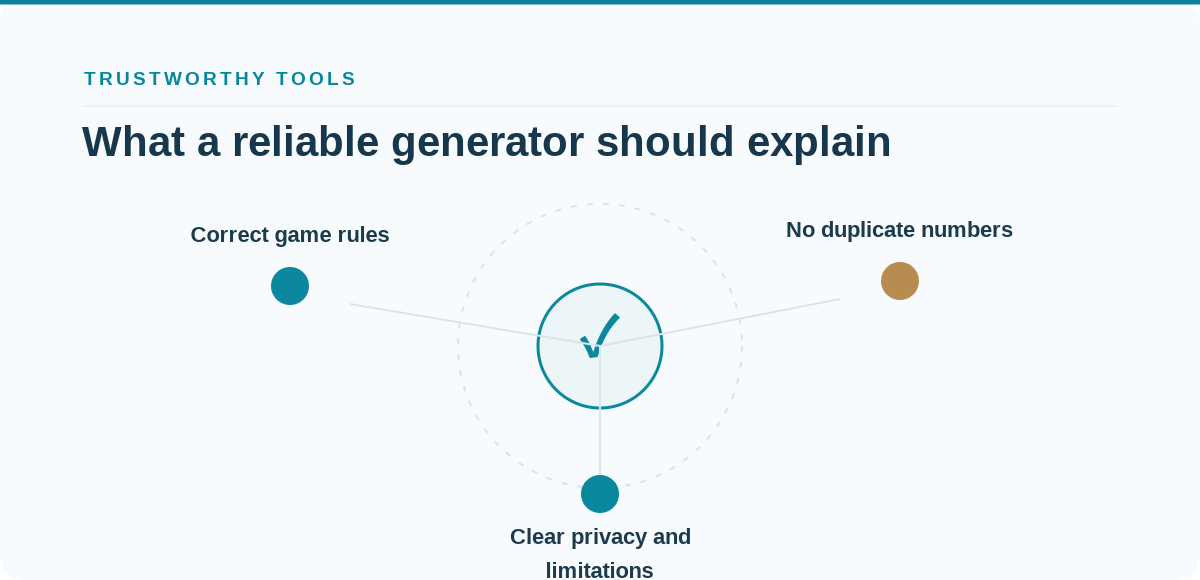
Open the generator for a game you know. Does it ask for the correct number of main balls? If the game includes a separate special-number pool, does it handle that separately? Does it avoid duplicate main numbers within a standard line?
For EuroMillions, five main numbers and two Lucky Stars are required. A site that produces seven undifferentiated numbers has not understood the format. The output may look plausible, but it is not an equivalent standard selection.
The same test applies to less familiar international lotteries. The numbers should match the game, not a generic template with a flag pasted above it.

Randomness should have an explanation
A site does not have to publish its entire engineering manual, but it should say what kind of selection it uses. A browser tool may use crypto.getRandomValues(), the Web Crypto API for cryptographically strong random values. The browser's randomness source is one component; how those values are mapped into valid lottery choices matters too.
A subtle issue is selection bias introduced by the conversion process. If software maps a large integer range into a smaller one carelessly, some outcomes can receive slightly more weight. An unbiased mapping method, such as appropriate rejection sampling, avoids that problem.
This matters to the quality of the generator. It still does not make its selections more likely to win a fair official draw than anyone else's valid combinations.
The second test: Does the website promise the impossible?
Be sceptical of phrases such as “guaranteed winning numbers”, “secret algorithm” and “AI predicts tomorrow's draw”. A fair, independent drawing is not made predictable simply by feeding previous results into a model.
Historical frequencies can be studied; prediction claims require separately verified evidence. A transparent free tool will distinguish between random selection, user preferences, historical analysis and genuinely demonstrated forecasting accuracy. Those are not interchangeable.
Also look for practical details: who runs the site, where its rules come from, how to report mistakes and whether it explains that it does not sell official tickets. These sound like editorial concerns, but they are part of whether you should trust a tool.
What does “free” mean if the site earns advertising revenue?
A free website can be supported by advertising without charging the visitor for the core number-selection tool. But a visitor still deserves clarity about which material is advertising, what data or cookies are used, and whether the tool depends on granting unrelated marketing permissions.
For a responsible publisher, the distinction between a useful free tool and a misleading commercial funnel is important. Relevant advertising can coexist with educational content; advertising should not make the visitor believe an official lottery has endorsed a generator when it has not.
Similarly, paid links should be identified appropriately, and territorial restrictions must be respected. A visitor should never be pushed into purchasing tickets simply because they requested a random line.
The simplest test is to use the site as a reader would: can you complete the intended task easily, understand the results and see any material commercial relationship without hunting through obscure footnotes? If yes, “free” is more than a headline.
Privacy is more important than decoration
A number generator ordinarily has no reason to demand payment card details, identity documents or full account registration simply to select a few numbers. Some services may offer accounts for additional features; that is a separate choice, not a technical necessity for generating numbers.
Check the site's privacy notice and avoid entering personal details into arbitrary text fields. If a website claims your selections are processed entirely in your browser, look for a clear explanation instead of treating the statement as automatic proof.
A five-minute side-by-side test
Open two free generators for the same official lottery and request ten standard lines from each. Do not compare their “luckiness”; compare their accuracy. Are the number pools correctly labelled? Are values valid? Can you identify which selection mode is active? Are special balls separated? Does the website make it easy to find an explanation of the algorithm?
Now inspect the small print. If one site quietly adds a “hot numbers” filter by default, it is not doing exactly the same job as a uniform random tool. The difference may be a deliberate feature, but it should not be concealed.
Finally, ask what happens if the site disappears tomorrow. Can you retrieve your numbers without surrendering personal information? Do you have a readable copy? Does the website make clear that those numbers do not constitute an official ticket?
The result of this comparison is not a ranking of which tool will win more jackpots. It is a much more useful ranking of which tool can be understood, trusted and used without unnecessary friction.
A free-tool test you can repeat
Open a generator and request ten valid lines for the same game. Check the count, the permitted range and the absence of repeated main numbers within each line. Then change the game: does it correctly switch between one-pool and two-pool formats? These checks test the tool’s basic usefulness. Ten lines cannot prove statistical uniformity, and an attractive interface is not evidence of predictive power.
A short real-world checklist
Before making any generator your regular choice, ask whether its lottery rules are current; whether it produces valid combinations; whether the selection method is explained; whether unnecessary personal data is requested; whether the results can be copied or saved as needed; and whether marketing claims are proportionate to the facts.
LottoLuma provides a lottery directory, a general random number generator and a public methods and sources page. Those are useful starting points for evaluating what the tools claim, including their limitations.
A free generator does not need to be magical to deserve a place in your bookmarks. It needs to be accurate about the rules, straightforward to use and boringly truthful about the odds. That is an unexpectedly high standard in a corner of the internet that likes extraordinary promises.
Sources and further reading
- MDN Web Docs — Crypto.getRandomValues()
- LottoLuma — FAQ and number selection methods
- LottoLuma — methods, sources and limitations
Reference links support the article's factual and technical framework. Verify the current game version and editorial wording again before publication.