



A generator can look polished and still get the fundamentals wrong. Attractive coloured balls are not evidence that the underlying selection respects game rules, privacy or randomness. The best way to judge reliability is to give the tool a set of questions it cannot answer with decoration alone.
Test 1: Does it know the exact lottery format?
Pick a game with separate number pools, such as EuroMillions or Powerball. Does the tool distinguish the main balls from the special balls? Are all values in the right range? Does it stop repeated main numbers where repetition is not permitted?
A generator that fails the basic format test is not reliable for that game, even if its output is visually convincing.

Test 2: Is the selection method described?
Look for meaningful words rather than marketing slogans. “Secure random”, “balanced”, “weighted by history” and “manual preference” describe different processes. A good site tells users which process they chose and what that choice changes.
For a browser-based secure mode, the Web Crypto API is one relevant technical building block. How the program maps random integers to the selected lottery range matters as well.
Test 3: Can it produce unusual but valid lines?
Try generating several results. If every line has an identical odd/even split or avoids consecutive numbers, a supposedly unrestricted random mode may be applying hidden constraints. That is not proof of a flaw, but it is a reason to investigate the settings.
A fair draw can produce clusters. An honest unrestricted generator must not silently rule them out merely because they look strange.
Test 4: Does it distinguish preferences from predictions?
A generator may allow you to avoid numbers, lock favourites or analyse earlier draws. Those are choices about how the tool builds lines. They do not improve a valid combination's chance of being selected by an independent official draw.
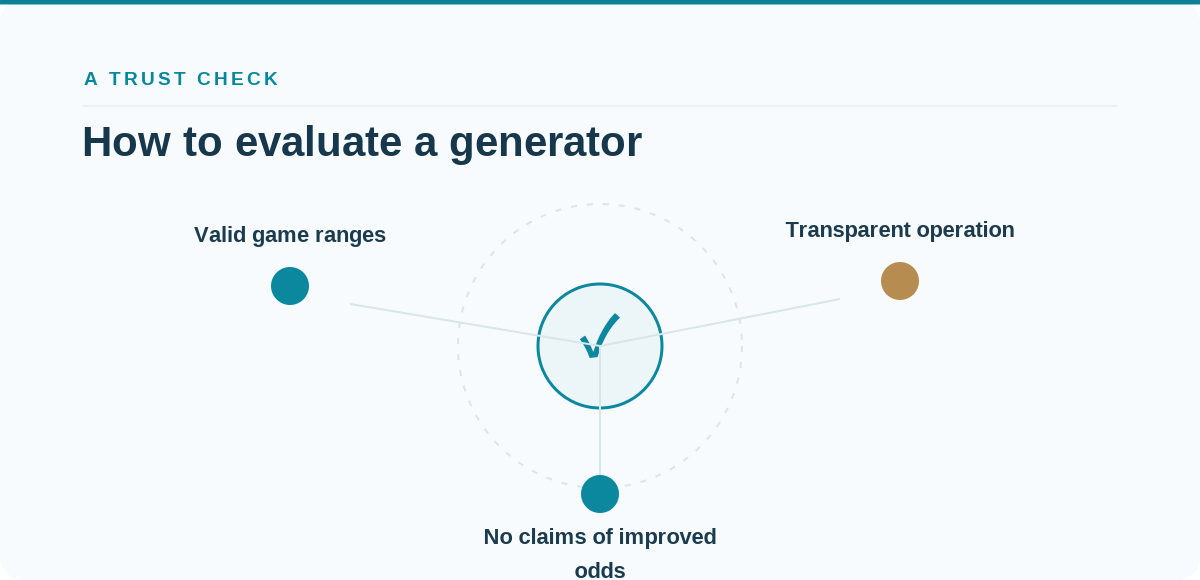
Be wary of claims that any feature guarantees higher accuracy or winning chances without rigorous evidence.
The transparency test when a site is wrong
No online service can credibly claim it will never make a mistake. A lottery game can change its selection format, and an independent website might not update every page immediately.
A trustworthy service makes corrections possible: users can identify the incorrect rule, see where it came from, contact the operator of the site and understand when the published information was last reviewed.
That matters more than a generic “100% accurate” badge. The best editorial and technical systems document their limitations and respond to new evidence.
Suppose a user reports an out-of-range special ball on a game page. The right response is to check the official game specification, correct the configuration, test the generator and explain what changed. Pretending the issue cannot happen would make the site less reliable, not more.
Test 5: Does it keep your data needs modest?
Why would a simple generator require your passport details or card number? It usually wouldn't. A trustworthy site explains what information is stored, whether accounts are optional and how selections can be saved or deleted.
Privacy notices should describe real behaviour, not just contain reassuring words.
Test 6: Can you find the operator and source references?
Look for a clear about page, contact route, a description of what the site actually does and current links to official game rules. Rules can change — UK Lotto adopted a two-round structure in June 2026 — so undated odds tables deserve caution.
The LottoLuma methods and sources page provides a useful example of documenting formats and limitations; its FAQ explains the selection modes.
The test that catches a surprisingly common problem
A generator produces ten very tidy lines, each with exactly three odd and three even numbers. This may be the intended result of a balanced-selection mode. But if the interface calls the mode unrestricted random without explaining the constraint, it has made a significant omission.
In a fair six-from-59 draw, all-even and all-odd combinations are valid. The total population of combinations does not consist exclusively of neat three-and-three splits. Hiding an unrequested filter alters what the tool can produce.
Another practical test is to check whether a generated line remains visible and labelled after you switch the selected game. If the output was created under one game's range, continuing to display it as if it belonged to another game can mislead users even when the original selection was perfectly valid.
Trustworthiness is therefore not a single property of a random algorithm. It also depends on how transparently the interface communicates settings, game changes and limitations.
A small acceptance test
Try three intentional mistakes: request more distinct main numbers than exist in the pool, ask for a value outside the permitted range, and switch between a game with a bonus pool and one without. A trustworthy interface should explain or reject invalid requests instead of silently inventing a format. This checks input validation; it does not, by itself, certify the underlying random generator.
Test 7: Is the final result practical?
Can you read the numbers on a phone? Copy them without errors? Tell which game and format produced the line? If there are multiple lines, are duplicates clearly handled? Reliability is not only about mathematics. It is also about preventing ordinary human mistakes.
A genuinely good generator passes all seven tests without making extravagant promises. When you find one, it should feel less like a mysterious prediction engine and more like a well-made calculator: straightforward, explainable and careful about its limitations.
Sources and further reading
- MDN Web Docs — Crypto.getRandomValues()
- LottoLuma — FAQ and number selection methods
- LottoLuma — methods, sources and limitations
- Allwyn UK — June 2026 Lotto game changes
Reference links support the article's factual and technical framework. Verify the current game version and editorial wording again before publication.