



A lottery-number generator should be one of the simplest things you do online. You choose a game, press a button and receive some numbers. If the website demands extensive personal details, floods the page with scripts or makes its privacy practices impossible to find, it is reasonable to ask why.
Security concerns the website and your data as well as the mathematical quality of its number selections. Those are related, but not identical, questions.
A safe selection process starts with modest data collection
You should not normally need to supply a bank account, passport scan or full home address just to generate a random line. Accounts may be justified for optional synchronisation or saved-history features, but those should be described as additional services rather than required for choosing numbers.
Check the privacy notice, cookie and advertising controls, and whether the page works without unnecessary permissions. Avoid using tools that treat a simple generation request as a reason to collect sensitive information.

Browser randomness has a documented technical basis
Modern browser environments provide crypto.getRandomValues() for cryptographically strong random values. Mozilla's MDN documentation describes the interface and its properties.
That is a useful ingredient for a random generator, not a blanket security certificate for the entire site. A website could use a sound randomness source while still having insecure forms, misleading advertising or a poor privacy policy.
The application code must also map random values into permitted ranges without unintended bias and enforce the game's selection rules correctly.
What HTTPS does and doesn't guarantee
An HTTPS connection protects data in transit between your browser and the website under the connection's security model. It does not prove that every claim on a webpage is accurate, that the operator is reputable or that every embedded third-party service respects your preferences.
Be suspicious of forced downloads, unusual browser permission requests and promises that you must install a proprietary app to reveal “guaranteed” numbers.
A safer approach to shared links and screenshots
It is tempting to post an image of an actual lottery ticket when asking a friend to check the numbers. The image may reveal more than the chosen numbers — including a barcode or other information connected with the ticket.
For a conversation about number selection, share only the numbers and game format. Keep purchase records and identifying details separate and secure.
The same principle applies to copying a selection into a chat assistant or a third-party “prediction” website. There is rarely a good reason to supply account data just to discuss a combination.
Strong privacy behaviour doesn't require complicated technology. Often it starts by sharing less information in the first place.
Advertisements and affiliate links deserve separate scrutiny
A free website may support itself through advertising or affiliate arrangements. That business model is not inherently a problem. What matters is transparency, consent handling, restrictions on sensitive targeting where applicable, and whether advertising is clearly distinguished from the website's independent editorial content.
A generator should not disguise an affiliate purchase path as the only route to receive a randomly selected line.
Questions to ask about a “private by default” claim
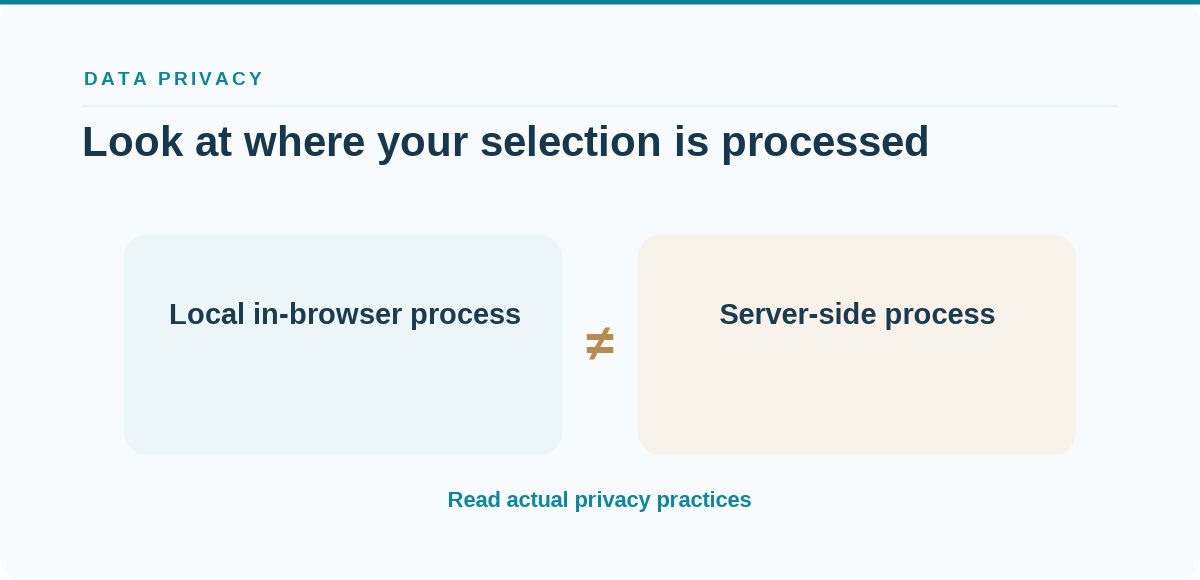
Does the site process the numbers locally in the browser, or send them to a remote server? Does the page save choices in browser storage? If so, how can they be cleared? Are embedded advertising or analytics services independent of the number-selection function?
These questions are not accusations. They are the details that make a privacy statement meaningful. A user should be able to find an understandable description of the behaviour rather than an untestable promise.
Another relevant distinction is between the secrecy of a number choice and the security of an actual lottery account. Generated numbers may be harmless to share, but purchased ticket barcodes, identity details and account credentials may be sensitive.
Good advice keeps those two categories separate and never asks someone to send official ticket credentials merely to receive a random selection.
Security has at least three layers
Ask whether the generator uses a suitable random source, whether the page collects personal details it does not need, and whether saved selections remain private. These are different issues. A site could use technically strong randomness while collecting unnecessary data, or have an excellent privacy policy while using weak random-number logic. Check both.
A practical trust checklist
Look for an accurate explanation of the tool, a contact and correction route, current game rules, clear privacy controls, no unnecessary registration, and reasonable advertising behaviour. Review the site's own public pages rather than relying on trust badges alone.
LottoLuma's FAQ, methods page and responsible-play information describe its stated approach. Users should still make their own decisions about what services they trust.
A random-number generator should feel boring in the best way: it asks for little, explains its job and produces a valid line without turning a quick task into a security gamble.
Sources and further reading
- MDN Web Docs — Crypto.getRandomValues()
- LottoLuma — methods, sources and limitations
- LottoLuma — safer lottery participation
Reference links support the article's factual and technical framework. Verify the current game version and editorial wording again before publication.