



Two people, perhaps living hundreds of miles apart, can independently generate the same lottery combination. There is nothing suspicious about that. Every valid line comes from a finite set of possibilities, so duplicates are unavoidable in principle — especially when enormous numbers of tickets are sold.
What happens next depends on whether the matching lines actually become valid official tickets, whether the line wins and how the operator distributes prizes.
A duplicate combination is not an impossible coincidence
In a six-from-59 lottery, there are 45,057,474 possible unordered combinations. If two independent tools select uniformly, the probability that the second produces exactly the same six-number line as the first is one in 45,057,474.
That sounds tiny, but it is a different question from the chance of finding at least one duplicate somewhere among a large group of independently generated lines. With many selections, there are many possible pairs to compare. This is related to the birthday-paradox effect.
A matching generated line is not proof that one tool copied the other.
What if the same combination wins?
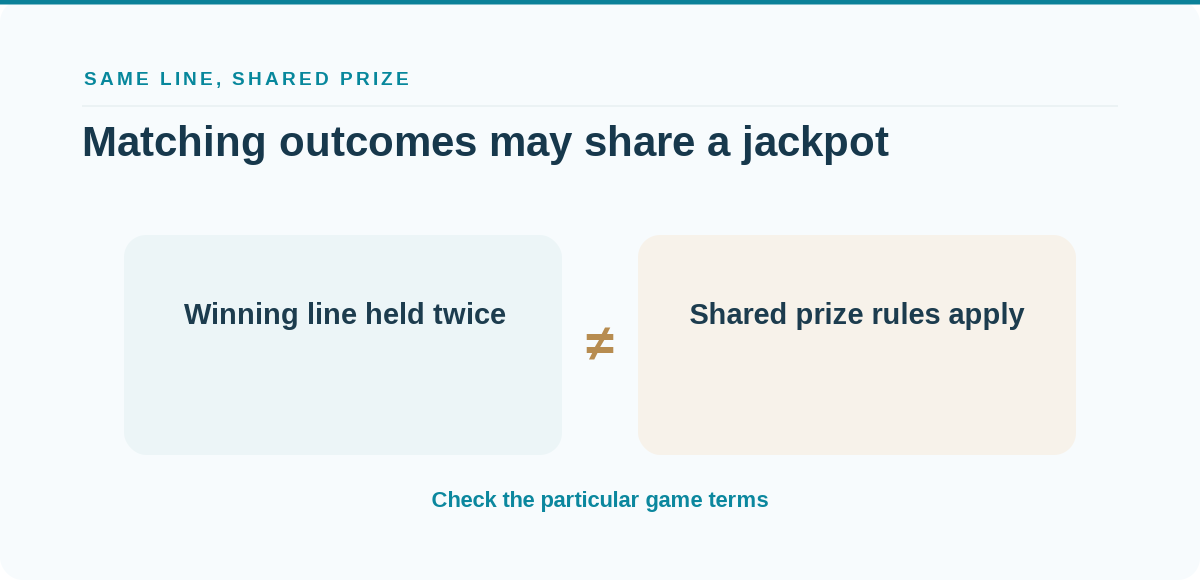
Some lotteries share a top prize among qualifying winning tickets. If two separately purchased tickets carry the winning combination, the total number of qualifying winners may affect how the prize is divided.
But prize structures differ, and duplicate-ticket consequences cannot be summarised with a universal “the jackpot is always split in half” rule. Read the official game-specific procedures for the relevant prize tier.
A saved number line in an app does not itself entitle the holder to a prize. The entry must be validly accepted by the operator.
The sharing question has two independent parts
First ask whether two people have genuinely purchased valid official tickets for the relevant draw. Second ask whether the winning prize division in that game depends on the number of qualifying tickets.
A number generator can help you identify that two saved combinations are identical. It cannot confirm either person's entitlement to a jackpot, settle a disagreement about who owns a ticket or establish the operator's prize division rules.
A third-party page claiming “you will receive half if one other person chose the same numbers” is therefore oversimplifying. The number of qualifying winners, relevant prize pool and game-specific procedures all matter.
The useful lesson is to keep generated numbers, official ticket ownership and prize claims in separate records.
Duplicates among your own saved lines
If you are organising multiple selections, it helps to identify exact repeats. Since main-ball order usually does not affect a draw-style combination, sorting the main numbers before comparison prevents a reordered line from slipping through.
For multi-pool games such as Powerball, include the red ball in the comparison. Two lines with identical white balls but different red balls are not the same full combination.
LottoLuma's generator guide discusses multiple lines, and its game directory helps distinguish different lottery formats.
A birthday-paradox-style example
In a toy lottery with 100 equally likely full combinations, two independently generated lines match each other with probability 1/100. But when 20 lines are generated, there are 190 possible pairs among them. You should not expect all those comparisons to be independent; still, the growing number of pairs explains why a duplicate somewhere in a collection becomes much less surprising.
The exact probability that all 20 independent uniform selections are different is (100/100) × (99/100) × ... × (81/100). The chance of at least one duplicate is one minus that product.
This does not directly tell you the sharing probability for an actual lottery because ticket sales, human number preferences and operators' prize rules all matter. It simply demonstrates why two people receiving the same line is not evidence of a faulty generator.
The right operational response is ordinary record-keeping and checking the official rules, not assuming the same combination has some special status.
Winning and sharing are different calculations
The probability that a particular combination is drawn comes from the game format. How much a winner receives can also depend on how many other valid entries matched and on the game’s prize-sharing rules. A less common-looking selection does not change the draw probability, and it does not guarantee that nobody else selected the same numbers.
The human part of sharing
Lottery groups should record who owns a ticket and what agreements apply before any result is known. An informal verbal promise can be difficult to interpret after a major prize. The Irish National Lottery publishes a syndicate agreement template illustrating this organisational concern.
The same numbers can belong to different people. The real question is not whether the coincidence was magical; it is which official entries exist and what the published prize rules say about them.
Sources and further reading
Reference links support the article's factual and technical framework. Verify the current game version and editorial wording again before publication.