



Two identical tickets can look like a harmless mistake. But if your goal is to represent different possible draw outcomes, the duplicate is important: you have purchased or recorded the same combination twice, not covered a new one.
Whether that matters depends on what you are trying to achieve and on the lottery's prize rules. It is not a reason to spend more.
Duplicates within a line versus duplicates between lines
There are two distinct problems. A standard six-from-59 line should not repeat a main number within the same combination. Choosing 4, 4, 12, 19, 31 and 47 is not a valid standard selection.
Between different lines, the situation changes. You can write down exactly the same valid six numbers twice. Those two lines are duplicates of one combination. A generator should make it clear whether duplicate lines are allowed, independently of whether repeated numbers within a line are allowed.
A small example exposes the difference
Suppose your first line is 3, 11, 22, 35, 44 and 57. If the next line contains those same six numbers in a different order, it is still the same unordered combination.
You can avoid this by sorting a copy of each line into ascending order and comparing the sorted sequences. A simple data structure known as a set can keep only distinct signatures.
For games with a separate special-ball pool, both main and special selections must be included in the comparison. Identical main numbers with different Powerballs, for instance, represent different full combinations.
What duplicate prevention does not do
Removing duplicates from a set of selections increases the number of distinct combinations represented within that set. It does not increase the chance of any particular combination appearing.
And buying duplicate official tickets may have prize-payment consequences under the relevant operator rules. Some prizes are shared; multiple eligible tickets can affect entitlement differently depending on the game. Always read those rules rather than assuming that duplicate tickets either double a jackpot or have no value.
A duplicate line can be intentional
Sometimes users deliberately save the same combination under two different draw dates. That is not necessarily an error. A line for Wednesday and the same line for Saturday describe two separate intended events, even though the numbers are identical.
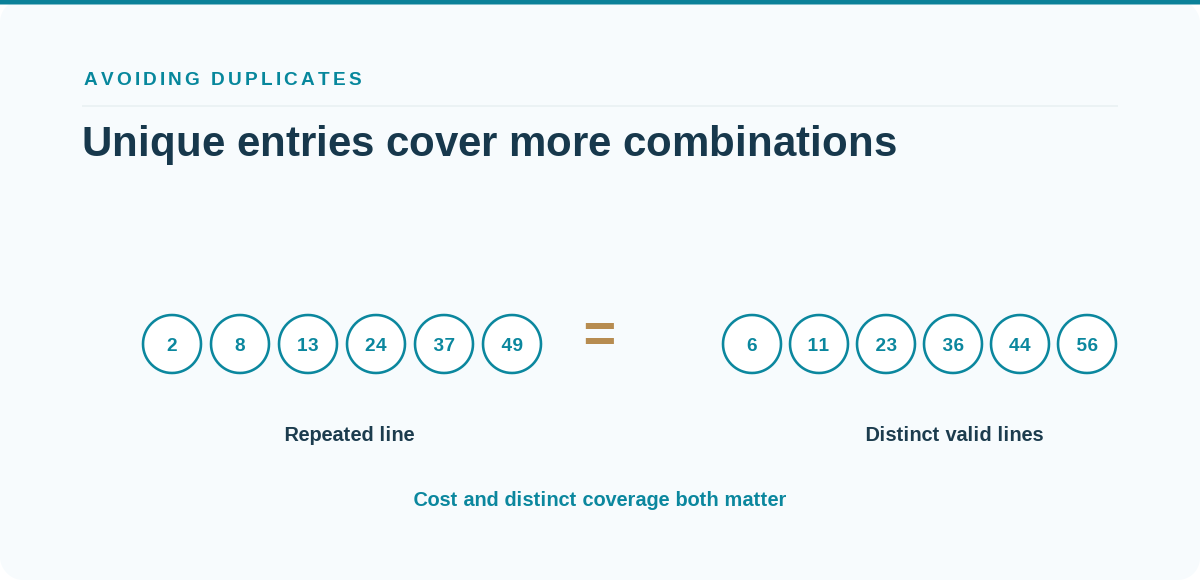
This is why a duplicate checker should clearly state what it compares. “Duplicate combination in this batch” is different from “same numbers have appeared in your saved history”. One concerns the organisation of a current list, the other a record of choices across time.
Similarly, two official tickets carrying the same numbers may exist under the operator's rules. An independent tool should not declare either ticket invalid merely because it recognises matching digits.
Good software flags the situation and lets the user understand it. It should not silently delete data or make unsupported assumptions about the associated prize rights.
Why export labels and dates help
If you keep records across multiple draws, include the game, date, selection format and special balls. Otherwise a line from one lottery might be mistaken for a line from another, or a historical line may be labelled as if it were part of a later entry.
Storing the complete sorted combination allows meaningful duplicate comparisons. Repeatedly generating numbers with no clear record can produce confusion rather than better organisation.
A clear duplicate-checking algorithm
For an unordered game, start by sorting each line's main numbers. Join the sorted values with a consistent separator to form a signature. If the game has a separate special-ball pool, add its sorted signature after a distinct delimiter. Two lines with identical signatures represent the same full combination.
This is suitable for a spreadsheet or a small script. It also provides an opportunity to preserve the original display order separately if that matters to the user.
Remember that duplicate checking is format-specific. In games where number order is part of the actual selection, sorting would incorrectly merge genuinely different entries. That is why the game rules must be established before building the comparison algorithm.
A sound tool should explain these assumptions instead of reporting a generic duplicate count without context.
Coverage illustrated with two lines
Suppose a single fair draw has N possible winning combinations. Two distinct valid lines correspond to two different potential jackpot results, giving a combined jackpot-hit probability of 2/N if the outcomes are mutually exclusive. Two identical lines correspond to just one potential winning combination, so the event probability stays 1/N. The financial consequences of buying duplicates depend on the game’s rules.
A sensible practical workflow
Generate the number of examples you actually need; check the game format; normalise each selection for comparison; flag exact duplicates; and save the final list with an explicit date and game title.
LottoLuma's generator guide explains its handling of multiple generated lines. For a more flexible workspace, the general random-number generator provides number and group options.
A duplicate checker is a housekeeping feature. It protects the clarity of your list, not your wallet from lottery mathematics.
Sources and further reading
Reference links support the article's factual and technical framework. Verify the current game version and editorial wording again before publication.