



Generating one lottery line is trivial. Generating 30 distinct, correctly formatted examples for a classroom activity or personal reference list introduces new problems: accidental duplicates, unclear game labels, missing special numbers and records you cannot identify later.
The fastest useful process is not merely the one with the fewest clicks. It is the one that produces a clear, valid, verifiable set without requiring you to tidy up afterwards.
Pick the format before the quantity
Choose the lottery first. A batch of UK Lotto-style six-number lines is not interchangeable with Powerball's five white balls and red ball. If you need examples from several games, keep the collections separate and label each format.
Next choose how many lines you actually need. For an educational demonstration, 20 or 30 may be a convenient sample. That does not imply anyone should buy that many official tickets.

Decide what “unique” means
A standard draw-style combination is usually unordered. The lines 4, 11, 19, 28, 36, 54 and 54, 36, 28, 19, 11, 4 represent the same six-number combination.
To detect exact duplicates, sort the main-ball portion before comparing. For games with special-number pools, include each pool in the signature separately.
Some generators prevent duplicates across the lines in a batch. Others generate independently and may repeat a previous combination. Neither behaviour should be a hidden surprise; the interface should explain it.
Organise the output as you go
A useful exported or saved record contains the lottery name, generation date, selection mode and separate columns for main and special numbers. The record should say “generated selections”, not “purchased tickets”.
If you need to copy the lines into a spreadsheet, use a structured format where possible. A screenshot can preserve appearance, but it is harder to search for repeated combinations later.
Speed can hide errors unless results are labelled
Batch generation is particularly vulnerable to confusion when several lotteries are selected at once. A user may export hundreds of rows and later forget which special-ball range was used for which group.
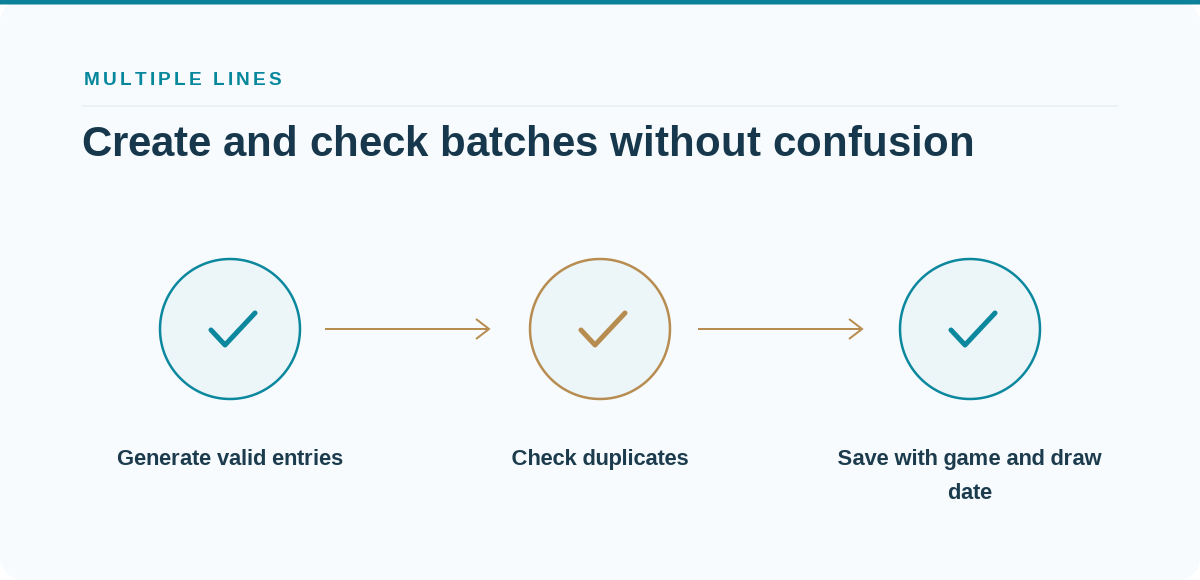
Organise the output by game and generation method before saving it. If the tool supports export, open the file and verify that the headings remain attached to the correct lines. This is a better test of usefulness than simply timing how fast the numbers appeared.
For accessibility, a large result list should also remain readable without relying solely on coloured ball graphics. Text labels, clear separators and responsive layouts help a person verify what was actually produced.
A genuinely fast tool saves time after generation as well as during it.
A small batch experiment
Try generating five lines in an unrestricted mode, then five more with an odd/even preference enabled. Count which sets contain the requested pattern. The difference reveals what a filter does to the output of the generator. It says nothing about which set the official draw is more likely to reward.
A spreadsheet can solve the final housekeeping problem
If you export a large batch, create a separate column that contains the sorted main-number signature and another for the special-number signature. A spreadsheet's duplicate-highlighting feature can then reveal repeated full combinations without relying on their original display order.
For multi-game datasets, include the game identifier in the signature. Otherwise the same digits appearing in two completely different lottery formats could be mistaken for duplicate entries, which they are not.
Include a field explaining whether each line is a random example, a saved manual selection or an official purchased entry. A number generator should never silently promote a generated example into the status of a ticket.
The goal is fast and clear. A one-click batch is not particularly useful if the output requires another hour of detective work to understand.
Batch workflow without the clutter
When preparing several demonstration lines, generate a small batch, keep one consistent game label and remove exact duplicate combinations if you want distinct coverage. Store the selections with the date and generation method. This makes it possible to audit what was produced without treating the generated file as proof that any ticket was purchased.
Faster doesn't mean more profitable
Producing thousands of valid combinations can be computationally easy, especially in games with enormous sample spaces. The ability to generate them quickly must not be confused with a reason to purchase them.
A generator is at its best when it removes repetitive work while keeping the results understandable. LottoLuma's how-to guide and general number generator are starting points for exploring batch selection and export options.
The ideal workflow leaves you with a tidy list and no mistaken impression that clicking Generate repeatedly creates an advantage over chance.
Sources and further reading
Reference links support the article's factual and technical framework. Verify the current game version and editorial wording again before publication.