



The quickest way to lose track of a lottery line is to save only the numbers. Six digits in a phone note might be enough for the next hour, but later you may not remember the game, the draw date or whether they were merely an example.
A useful export should capture the selection and the context that makes it understandable.
Which format should you choose?
Plain text is convenient for copying a few lines. A CSV file is better when you want to sort, search or identify duplicate combinations in a spreadsheet. A printable sheet can help with a group activity or an offline reference. A PNG or screenshot preserves visual layout but is less useful for automated comparisons.
No one format is best for every purpose. Choose based on what you will actually do with the information.

The fields worth including
For a draw-style game, keep the official game name, number ranges where useful, main numbers, special numbers, date generated, intended draw date and the selection method if it affects how the line was produced.
The distinction between generated and purchased is especially important. A number line on your computer is not an official ticket and is not evidence of a valid entry.
If you are keeping official ticket details, avoid exposing barcodes, account identifiers or personal data in publicly shared images.
Beware the order of numbers
When a standard lottery combination is unordered, the lines 5, 12, 21, 33, 44, 55 and 55, 44, 33, 21, 12, 5 are the same combination.
For duplicate checking, make a normalised sorted version. For a game with a separate special pool, store that pool independently rather than adding every number into one undifferentiated field.
These small choices can prevent a surprisingly large amount of confusion.
When an image is better than a spreadsheet
A clean graphic or printable card can be useful for showing a small set of example numbers to a group. It preserves layout, visual grouping and the distinction between main and special balls.
But if you need to sort hundreds of lines, identify duplicates or calculate frequencies, a structured text or CSV export is far easier to work with.
This is not a contest between beautiful design and good data. The best workflow may use both: a structured file for analysis and a visually clear card for presentation.
Always label the graphic with the game name and draw context, and avoid making generated examples resemble evidence of an official ticket purchase.
How LottoLuma fits into the workflow
LottoLuma's features guide describes its number cards and printable examples, while the how-to guide explains generator options and saved/exportable output where supported by the relevant tool.
Check the exact buttons on the game page you are using; not every studio necessarily provides every format or the same set of download options.
A simple CSV structure
A compact header might read: game,generated_at,draw_date,main_numbers,special_numbers,selection_mode,status. One row then describes one saved selection, rather than forcing you to infer its context from the file name.
If you share a file with friends, remove sensitive purchase information and personal identifiers first. If a site offers A4 print sheets, check the layout at print size; large decorative cards that work on a mobile screen may produce unnecessarily long or illegible printouts.
After exporting, import the CSV into a spreadsheet once as a test. Verify that separators, special-number labels and dates survive intact. If a number has a leading zero in an ordered-digit game, make sure the spreadsheet hasn't silently removed it.
A good export is not just a file that downloads. It is a file that accurately survives the next step in the user's workflow.
The minimum useful record
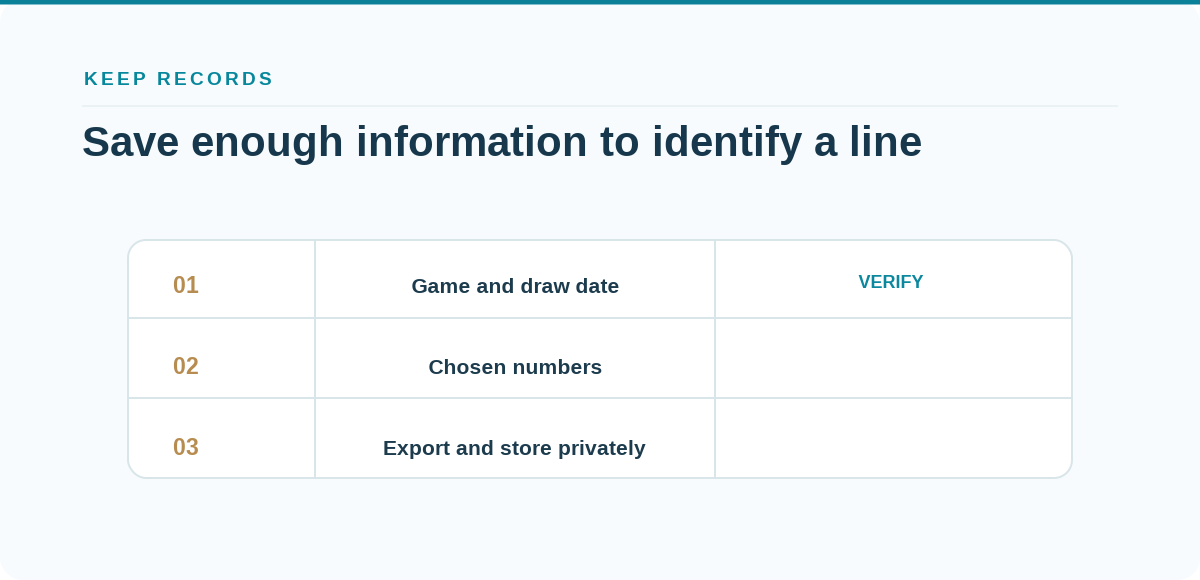
For every line, save the game name, number pools, selected numbers, date generated and any selection settings. If the record relates to an actual entry, keep a separate official ticket confirmation and draw identifier. A screenshot without the game name may be impossible to interpret months later, particularly when different countries use similar lottery names.
A final verification step
Open the exported file after saving it. Confirm that the numbers, special-ball labels, game title and dates survived the export. If printing, check that the main content is readable and there are no missing rows.
A beautifully designed export is only useful if the information remains accurate. Save the complete story of the line, not just the six numbers.
Sources and further reading
Reference links support the article's factual and technical framework. Verify the current game version and editorial wording again before publication.