


When somebody says they pick lottery numbers strategically, it is worth asking what they mean by strategy. Are they trying to improve the chance of an exact match, make the line feel personally meaningful, avoid sharing a possible jackpot or organise several entries efficiently?
Those goals are different, and so are the answers.
Strategy cannot make a fair draw favour your ticket
In a fair six-from-59 draw, any one valid unordered combination has the same probability of matching all six numbers as any other. Choosing one with a pleasing odd/even mix or without consecutive numbers doesn't change that.
If you apply a strategy that narrows the possible lines a generator may produce, you're changing the distribution of your selections, not the lottery's winning combinations.

The sensible uses of strategy
There are choices that can improve organisation. If you are preparing a predetermined number of lines for reference, you might avoid exact duplicates so the collection represents different combinations. If a game splits shared prizes, you might consider that popular human choices can affect potential sharing — but there is no guarantee an unusual line is unique.
A strategy can also be about expenditure: deciding in advance whether participation fits your budget and refusing to increase spending to recover losses.
None of those is a method for making an individual line more likely to be drawn.
What does genuinely random selection offer?
It removes some human preferences. People often gravitate towards dates, symmetrical layouts and numbers that look sufficiently scattered. A uniform generator does not need the output to look attractive. It can produce clusters, repeated patterns across different draws or consecutive sequences, all within the permitted combinations.
For somebody who habitually overthinks choices, pressing a single button can be a relief. It is a convenience advantage, not a probabilistic one.
Which method is easier to regret?
There is no universal answer. Some people feel worse after a manually chosen ticket loses because they remember spending time selecting it. Others feel they gave up control by using Quick Pick. A third group worries that changing long-used numbers will cause them to miss a win.
Those emotions are real, but they aren't evidence about the future draw.
If the selection process becomes stressful, a good response is to simplify it or step away. The goal of a lottery-number tool is to make the process more convenient, not to trap the user in endless second-guessing.
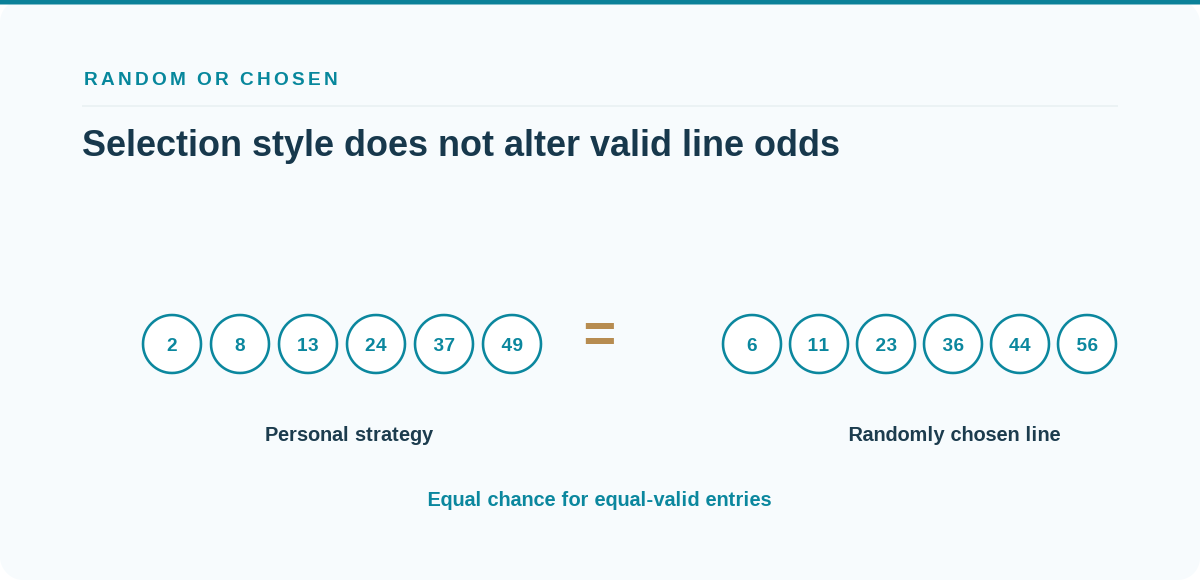
For an educational exercise, compare one personally chosen line with one uniform random line. Both are valid. Both have equal individual exact-match probabilities under the same fair game. The “better” choice is therefore about user experience, not lottery mathematics.
A decision table for ordinary users
If your aim is convenience, choose a well-documented random generator. If it is personal connection, use manual meaningful numbers. If it is learning probability, compare methods against the same theoretical odds. If it is tracking a set of lines, prioritise clear records and duplicate checks.
The one aim that neither method can responsibly promise is predicting a fair jackpot.
A subtle point about choosing “unpopular” numbers
There is a distinction between winning the lottery and the amount you might receive if you win. In some shared-jackpot games, other players choosing the same combination can affect the winner's prize share. This may motivate people to think about popular birthday-based lines or conspicuous patterns.
But the actual distribution of player choices is not necessarily public, and visual appearance is an unreliable guide to uniqueness. The trade-off also depends on the game's exact sharing and payment rules.
This is why “choose less popular numbers to win more” is misleading shorthand. A carefully qualified claim would say that other players' choices could affect a shared payout conditional on winning, while the probability of the official result matching your valid line remains exactly the same.
That is a different objective from predicting a jackpot, and it deserves a different discussion.
Strategy can describe a preference, not an edge
A strategy such as “choose three odd and three even” changes which combinations you are willing to select. It does not modify the official draw. Indeed, a fair draw can produce all-even or all-odd outcomes. Decide whether your goal is a personally satisfying line, a truly unrestricted random line or a simple record-keeping process; do not confuse those goals with improving individual winning odds.
An example of a misleading “strategy”
Suppose you select three odd and three even numbers because that looks balanced. The result is a perfectly valid line. But a fair draw could also produce six even numbers, five odd and one even, or any other eligible composition. Your rule has filtered away some valid combinations without making the remaining individual lines luckier.
LottoLuma's general random generator and game-specific studios let you explore different selection approaches. Read the methods explanation to distinguish unrestricted randomness from preference filters.
The best choice is the one that matches what you actually value about the selection process, with the mathematics kept in plain sight.
Sources and further reading
Reference links support the article's factual and technical framework. Verify the current game version and editorial wording again before publication.