


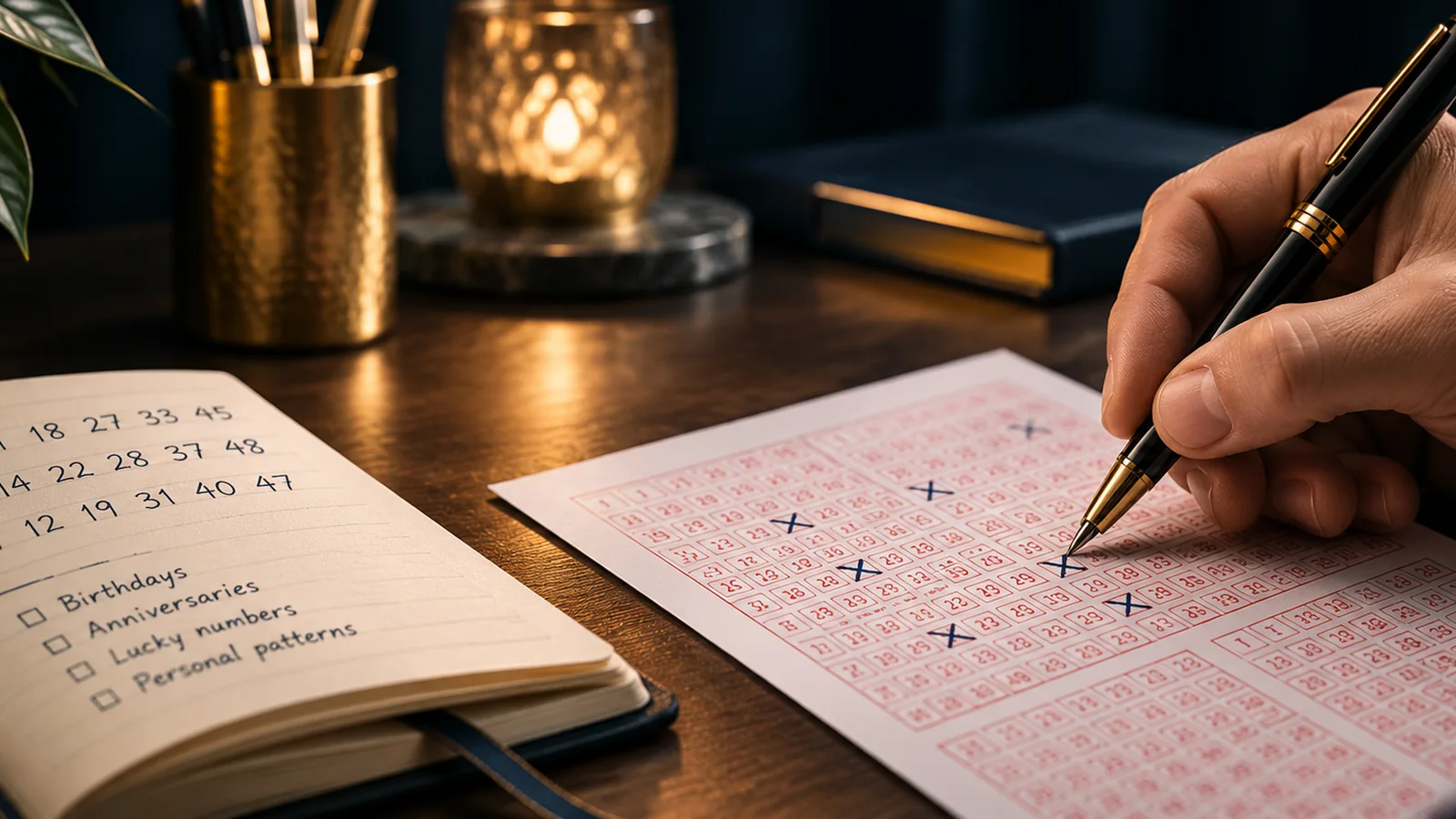
There is a particular satisfaction in filling in a lottery line yourself. Perhaps you start with a birthday, add a number you have always liked, and then stare at the last two empty spaces as if they contain a difficult crossword clue. Quick Pick would finish the job in a second. You would rather do it yourself.
That is perfectly reasonable. The trick is to distinguish a selection you enjoy making from a selection that has better odds. In a fair draw, every valid combination has the same individual probability, however personal its origins.
Start with the game's rules, not your favourite numbers
Before picking a single ball, establish how many numbers the game asks for and where they can come from. The UK's Lotto uses six main numbers from 1 to 59; EuroMillions uses five main numbers and a separate pair of Lucky Stars. These are different selection problems, and a list that works for one does not automatically work for the other.
Write down the number ranges, the number of choices and whether repetition within a line is allowed. Most draw-style games require distinct main numbers, but not all lottery products use the same format. Check the official operator's current instructions. A valid entry matters far more than a pleasing pattern.
Three ways to make the selection personal
The memory approach: Pick numbers associated with dates, addresses or milestones. Its appeal is sentimental; its limitation is that dates tend to occupy the lower end of number ranges. If everyone in your group follows this approach, you may also discover several people have chosen similar lines.
The mixed approach: Keep one or two meaningful numbers and fill the rest without trying to impose a pattern. You are combining a ritual you enjoy with a simpler process for the remaining spaces.
The fully manual approach: Look at the entire valid pool and choose without referring to any history chart or supposedly lucky sequence. You can even write each eligible number on identical slips and draw them without replacement. That is a homemade random generator, assuming the slips are mixed fairly.
None of these methods improves the probability of an individual line. What changes is your experience of choosing it.
Should you spread the numbers across the ticket?
Imagine one line containing 4, 11, 18, 27, 41 and 57. Now imagine another containing 11, 12, 13, 14, 15 and 16. Many people feel the first line is more believable. In a fair six-from-59 draw, though, both are equally likely as exact combinations.
A balanced-looking line may be more satisfying to select. It is not a mathematical advantage. If your manual method excludes consecutive numbers entirely, you are eliminating valid potential outcomes from your own selection process. The official draw does not make the same exclusion.
What if you want to change one number after seeing the line?
You can. A manual selection is not an exam, and there is no need to defend the first line you write down. The important thing is to be honest about why you're changing it.
Replacing a number because you realise you entered it incorrectly is a sensible correction. Replacing it because you dislike how the finished combination looks is a preference. Replacing it because you think last week's draw has made the number unlucky relies on an unsupported theory.
This distinction can make choosing numbers much less stressful. A line only has to be valid for the game and reflect the method you chose. It doesn't have to be mathematically beautiful.
If you repeatedly find yourself cancelling and reselecting because the numbers never feel right, that may be a sign the choice is taking more emotional energy than it deserves. The official drawing is unaffected by your hesitation, and there is no requirement to pursue an elusive perfect set of numbers.
Make a decision — then stop editing
The simplest manual method has four steps: confirm the rules; choose a complete valid line; check you have not repeated a number within the line; and save the choice exactly as intended. Avoid changing it simply because you see a similar pattern in a recent result. Prior draws do not make a valid combination due or overdue in an independent fair lottery.
If you are preparing several lines for reference, give each one a clear label. Distinguish between different combinations and duplicate copies of the same combination. Keeping records can prevent confusion, although selecting more lines for purchase increases cost and is not a way to make lotteries profitable.
A practical six-number example
Suppose you are choosing for a fair six-from-59 game and want to keep two family numbers, 8 and 21. Write those down first. Then choose four additional different numbers from the remaining eligible range, checking that none duplicates the locked pair. You might end up with 8, 21, 26, 37, 44 and 53.
This is a valid example selection for that format, not a recommendation to purchase a ticket. Another reader who chooses 1, 2, 3, 4, 5 and 6 has exactly the same chance of an exact match in one fair round.
An interesting exercise is to ask a friend to select six numbers and compare how much your lists overlap. Similarity might reveal shared preferences — birthdays or favourite shirt numbers — but it says nothing about which line the machine will select next.
If you want your own selection to remain completely manual, a quick range-and-duplicate check is enough. You do not need historical draw statistics, expensive software or a complicated “system” to select six valid numbers. The hardest part is often accepting that the task really is that simple.
A quick way to check a manual line
Write the game format at the top of your page: “6 from 59”, for example. Sort your six chosen numbers, then compare each neighbour. If any adjacent numbers are identical, you have selected the same ball twice. A sorted list also makes it easier to see accidental omissions. This simple mechanical check matters; rearranging the numbers because a sequence looks unusual does not.
An alternative when you want help with the boring part
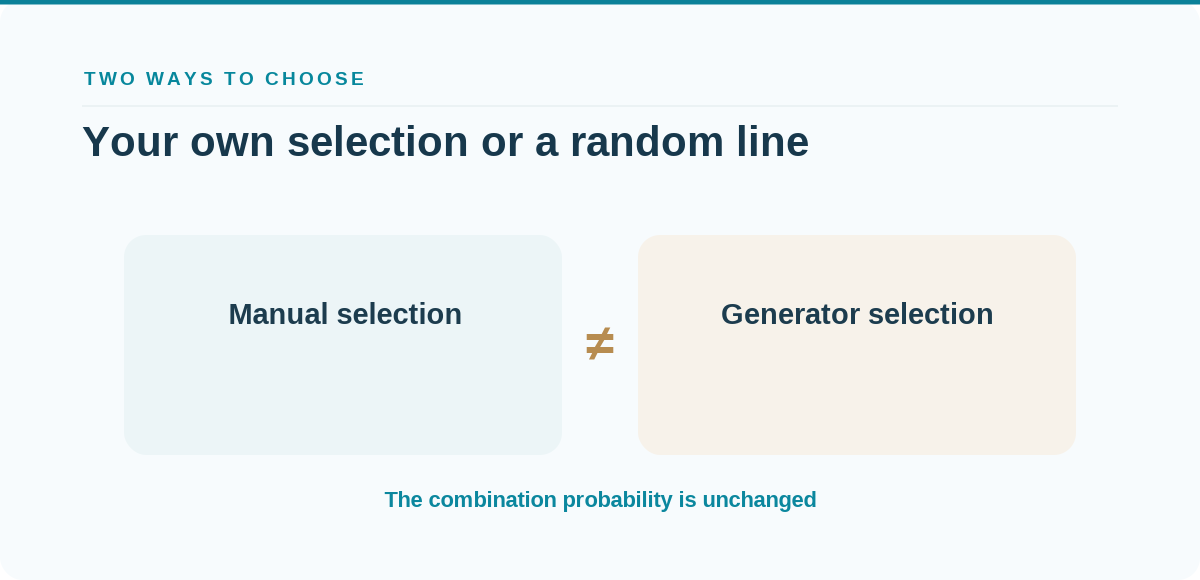
You can still call the numbers yours even if you use a tool to check the format or produce the unfilled positions. LottoLuma's game directory lets you explore individual game studios, while its how-to guide explains the selection options. Use a generator for convenience, or ignore it and choose everything yourself.
The best answer is the least mysterious one: pick a valid line that you are comfortable with, recognise that personal meaning does not influence random balls, and keep lottery participation within an entertainment budget.
Sources and further reading
Reference links support the article's factual and technical framework. Verify the current game version and editorial wording again before publication.