



Perhaps you always include number 8. Maybe you prefer a balanced mix of odd and even numbers, or you want to generate a set of example lines in one go. Customisation makes a generator feel more personal, but it can also make the mathematics look more mysterious than it is.
The distinction is simple: a setting may change which combinations the generator offers without making any selected valid line more likely to win a fair draw.
What common custom settings actually do
A locked number fixes one or more values in the selection. An odd/even filter restricts lines to a chosen balance. A range preference may exclude otherwise valid outcomes. A line-count control tells the software how many combinations to produce.
These are different operations, and they should not be described under a single vague label such as “smart selection”. Some produce uniformly random choices within a restricted subset; others deliberately weight some outcomes more than others.
Understanding the distinction helps you avoid confusing a personal preference with a forecast.

Custom ball counts need a warning label
An international number tool may let you request an unusual number of main balls for a classroom exercise. That can be useful, but the result may no longer represent a standard official ticket for the chosen lottery.
If a game normally asks for six numbers and you generate only four, you have created a custom mathematical selection, not necessarily a valid entry. Check the game's actual rules before using the output outside the tool.
The customisation setting you may want to undo
If you have been experimenting with number locks, odd/even filters or ranges, make sure the generator offers an obvious reset to its standard valid-selection mode.
Otherwise you may produce several new lines without realising an old restriction is still active. The output may remain valid for the game, but it no longer represents the method you intended to use.
Good interfaces reveal active preferences in plain language, not only through an obscure settings icon. They also explain whether a custom ball count is an educational variation or a standard official game format.
The ability to return to a transparent default is part of trustworthy customisation.
A favourite number does not become more likely to be drawn
Suppose you fix number 8 and ask a generator for five additional numbers in a six-from-59 format. Every line you receive includes 8 because you requested it. That doesn't affect the machine conducting the official draw.
The generator is conditioning its own choices on your preference. The draw is still independent. This is a useful example of how a chart can show 100% appearance of a number in your selections without implying an increased chance in winning results.
The mathematical effect of one locked number
In a six-from-59 game there are 45,057,474 possible unordered full combinations. If you insist that number 8 appears in every generated line, the program can only choose the other five numbers from the remaining 58.
That leaves C(58,5) possible lines containing your favourite. The generator will therefore output 8 on every request by design. But the official draw still has all its valid outcomes available, including those that do not contain 8.
The important insight is that 100% presence in your generated list does not mean 100% presence in the next official result. That sounds obvious when stated directly, yet it exposes the confusion behind many preferences marketed as predictive strategies.
A well-designed interface should make the restriction visible and easy to clear.
Filters change the output space
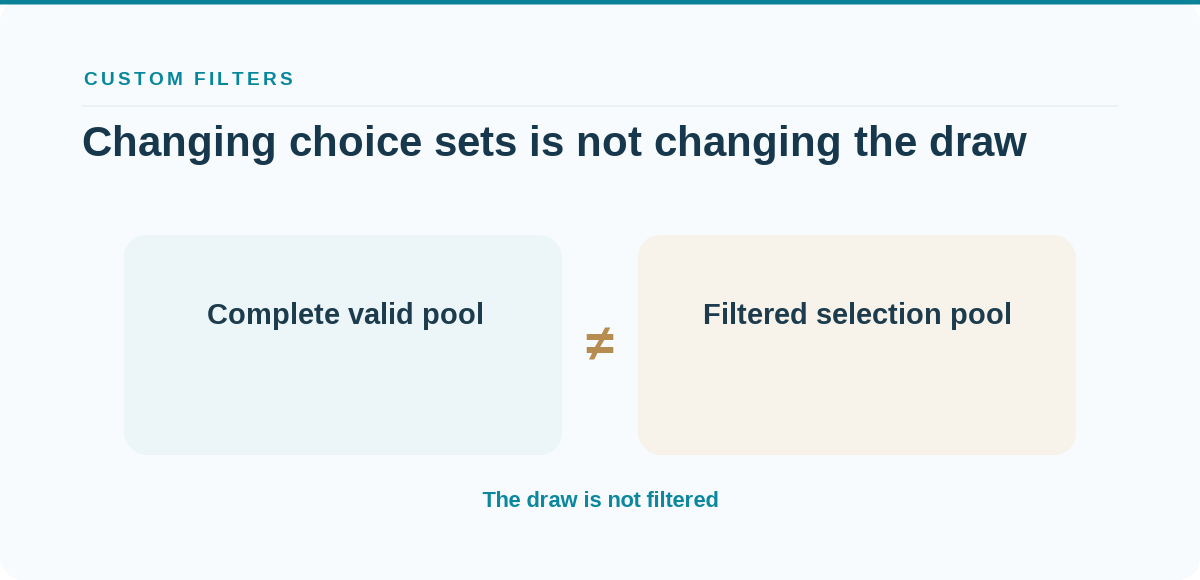
Imagine a six-number game that permits any combination from its published pool. A filter requiring exactly three odd numbers removes all otherwise valid combinations with different odd/even splits. That may suit your taste, but the official draw has not adopted the same filter. A customisation panel should say what it excludes rather than imply those omissions improve the chance of winning.
Design for clarity, not mystery
Good interfaces distinguish basic controls needed for a valid standard line from advanced preferences. A user should be able to return to ordinary unrestricted selection easily and understand when filters are active.
LottoLuma's guide, FAQ and game studios explain the selection options; available controls vary by game and should be checked on the actual page rather than assumed universally.
The strongest customisation is honest customisation: help readers choose numbers they like, clearly explain the consequences and avoid implying that filters bend probability in their favour.
Sources and further reading
Reference links support the article's factual and technical framework. Verify the current game version and editorial wording again before publication.