



Two buttons, two impressive labels: Random and AI. They may produce different-looking lottery lines, but the names don't tell you whether either has a better chance of being drawn. To make a useful comparison, ask what each system is actually doing.
Random selection has a narrow, testable job
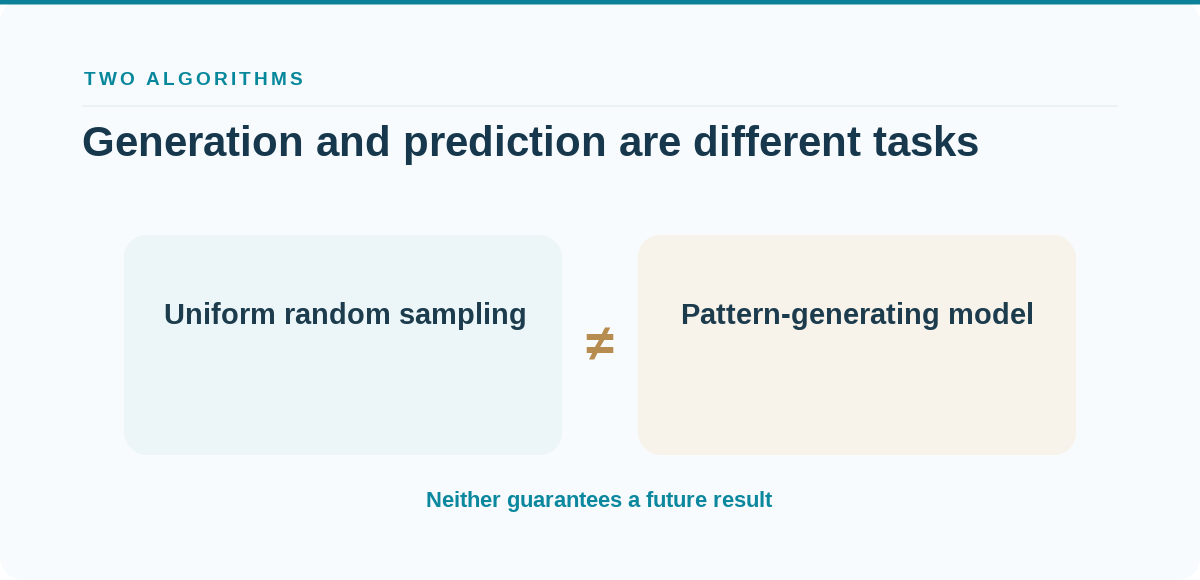
A standard uniform generator tries to select valid lottery combinations without favouring any eligible combination. Its job is not to analyse the future. It is to choose fairly within defined rules.
Take a six-from-59 lottery. There are 45,057,474 distinct six-number combinations. A properly implemented uniform selection method gives each combination a chance of one in that total when it produces one line. The official draw is a separate random process, so the method used to choose your line does not influence it.
AI can mean almost anything on a marketing page
An AI-labelled tool might use a language model, a machine-learning model trained on earlier results, a pattern detector or simply a random generator with a fashionable name. These are not equivalent systems.
A language model can write six numbers as text. That does not guarantee the numbers fall within the correct range or obey special-ball rules unless the output is validated. A historical machine-learning model can score numbers by previous appearances. That does not demonstrate a predictive edge in a fair independent draw.
Before comparing tools, identify the actual selection method, the output constraints and the stated purpose.
Here is a more useful comparison than “Which wins?”
Suppose you want to generate ten valid EuroMillions combinations for an educational demonstration. A game-specific random generator should know that there are five main numbers and two Lucky Stars, each from their own pool. A general-purpose AI assistant might produce the correct structure after careful prompting, but it still needs to be checked.
If your purpose is to explain why people overinterpret hot streaks, AI may be excellent at producing a plain-English explanation. If your purpose is uniform random selection, a purpose-built generator with clearly documented rules is easier to audit.
Neither ability translates into a proven increase in jackpot probability.
Does an AI-generated number list have to be random?
No. A language model might choose numbers because they resemble examples seen during training, because the wording of the question suggests a pattern, or because the model is trying to satisfy a request for “interesting” numbers.
That can be perfectly acceptable for a creative demonstration. It is not the same thing as an auditable uniform sampler from all valid lottery combinations.
A tool's description should therefore make clear whether it guarantees valid formatting, claims a particular probability distribution or merely proposes a plausible line. These are separate properties.
If the goal is a numerical simulation, the difference is especially important. A model that systematically favours pretty-looking numbers could distort a classroom experiment about uniform randomness. An ordinary secure-random number tool with a documented method is often a better choice for that task.
Ask one uncomfortable question of prediction claims
Has the AI model been tested on results it had not seen, against an appropriate random baseline, with the test set and scoring method disclosed in advance? A success story assembled retrospectively is not enough.
This is especially important when advertisements measure partial matches and present them as successful jackpot forecasts. Matching two balls in a line is not equivalent to matching every ball required for the top prize.
The AI-generated line that fails a simple rule check
Imagine asking a general AI assistant for one Powerball line. It responds with six numbers, all from 1 to 69, beautifully separated and written in ascending order. A casual reader might accept the result immediately.
The problem is that Powerball has a separate red-ball pool from 1 to 26. A sixth number of 54 cannot be a valid Powerball, however natural the line looks. A purpose-built Powerball generator should prevent that mistake by construction.
This illustrates a wider point about reliability. An AI model's ability to communicate in fluent sentences is not proof that it has enforced a game's data constraints. The output needs explicit validation, particularly for unusual lottery formats and games whose rules have changed recently.
Conversely, an ordinary program can produce valid random selections without being able to explain them beautifully. There is no reason to conflate those strengths.
Use the tool whose tested behaviour matches the job you need done.
Two outputs can look identical
A language model might return the numbers 5, 14, 23, 31, 46 and 57. A cryptographically secure number generator might return the same combination. The appearance of the finished line says nothing about how it was produced. The important questions are whether the selection mechanism is unbiased, whether it respects the game rules and whether any restrictions were imposed.
When to choose each tool
Use random selection when you want a straightforward, valid combination. Use AI as a research, writing or explanation assistant when you need to understand a rule or examine a dataset. If an AI system selects numbers for you, treat the output as a suggestion and verify it using the official game format.
LottoLuma's generator guide and general random tool focus on number selection, while its lottery odds tool explains the relevant mathematics.
A more sophisticated-looking method is not automatically a better one. Sometimes the plain button does exactly what you need — and promises no more than it can deliver.
Sources and further reading
- MDN Web Docs — Crypto.getRandomValues()
- Powerball — official prize and odds chart
- LottoLuma — methods, sources and limitations
Reference links support the article's factual and technical framework. Verify the current game version and editorial wording again before publication.