



Ask ChatGPT for six lottery numbers and you will probably receive six numbers. That's useful for a bit of fun, but it raises a technical question that is easy to miss: producing a plausible list is not the same as providing an auditable random-selection process.
AI assistants are good at following instructions in language. Lottery generators have a more specific responsibility: obey the game format every time and explain how their numbers are selected.
First decide what you want the assistant to do
There are at least three different requests hidden inside “generate lottery numbers”. You might want a playful set of favourite numbers, a line that obeys a specific lottery's rules, or a statistically uniform random selection.
The first is easy. The second requires accurate, current rules and validation. The third requires access to a suitable randomness source and an unbiased selection implementation — qualities you should not assume from a language model's prose output alone.
An assistant can give you numbers without having produced them using the same process as a purpose-built secure-random generator.

A prompt that avoids some obvious mistakes
For an educational example, you might ask: “Give me one example EuroMillions line with five distinct main numbers from 1 to 50, and two distinct Lucky Stars from 1 to 12. Label the pools separately. This is only a demonstration, not a prediction.”
After receiving the line, verify every value against the rules. If you are using a different national lottery, substitute its current requirements. Some games have supplementary mechanics that a simple assistant response does not represent.
Even a perfectly formatted line remains just a valid line. Its probability is not improved by a convincing explanation from the assistant.
A better prompt for learning than predicting
Try asking an AI assistant to explain a specific probability question instead of providing “the best numbers”. For example: “In a fair six-from-59 lottery, explain why the combination 1,2,3,4,5,6 is just as likely as 4,18,27,39,46,55. Show the combination count and distinguish one round from a multi-round ticket.”
That forces the conversation towards assumptions and mathematics. You can compare the result with a trusted probability calculator rather than judging the assistant by whether its suggested line looks lucky.
For a multi-pool game, ask the AI to list the pools separately before calculating the number of valid combinations. This often exposes misunderstandings early.
Finally, make sure the game rules used in the explanation are current. A model can confidently repeat an outdated lottery format, especially after recent operator changes. Verification is part of the task, not an optional extra.
Beware the promise of a “smart” forecast
A language model may notice that certain numbers appeared frequently in past draws and build an appealing narrative around them. In a fair independent lottery, those observations do not reveal the next random result.
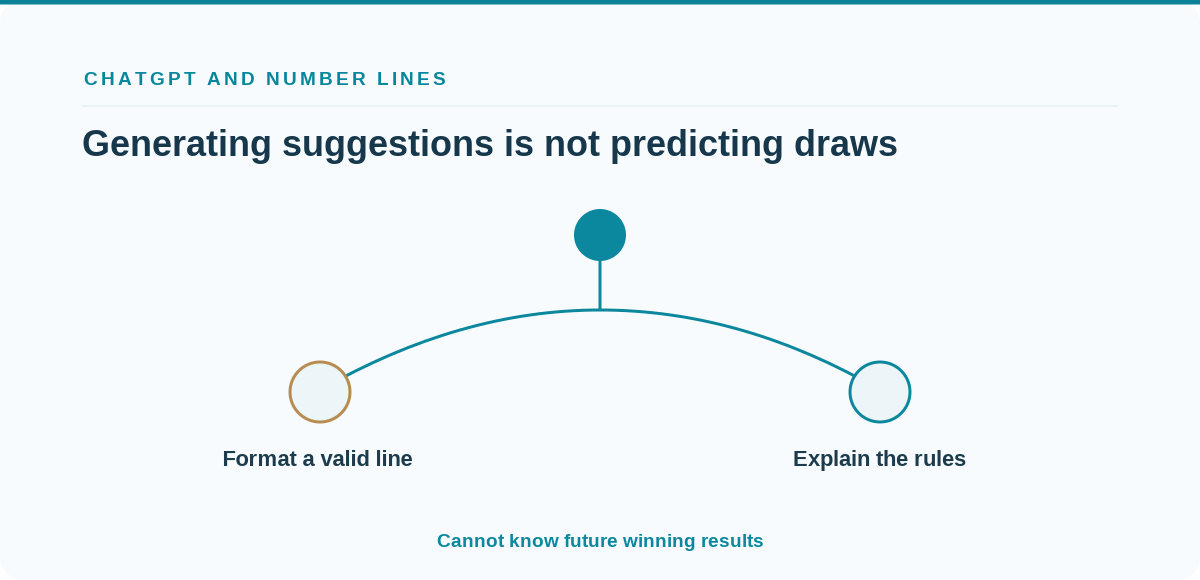
A realistic use for ChatGPT is to explain probability, help clean results data, describe common misconceptions or suggest ways to organise a personal record. These are useful tasks that do not require pretending the future is predictable.
If you want an unbiased selection from a specified range, a dedicated tool with an explicit random method is the clearer choice.
Three questions to ask an AI-generated line
After receiving numbers from an assistant, check whether every value is valid, whether the correct number of values appears in each separate pool, and whether the assistant has claimed a prediction it cannot substantiate.
A line may pass the first two checks and still fail the third. There is nothing inherently wrong with the assistant suggesting a random-looking collection for fun. Trouble begins when it adds a story about the line being “more likely” because of the last 50 results.
If you want to learn rather than merely select, ask the assistant to show the combination formula and explain the assumptions. Then check the calculation using a specialised probability tool or a reliable mathematical reference.
You can also ask for a comparison between two specific valid lines and their exact-match probabilities. In a fair unordered lottery, the honest answer is that they are equal, even if one line looks much stranger than the other.
That is arguably a better use of conversational AI than asking it to guess the next jackpot.
Treat text generation and random drawing separately
ChatGPT can explain lottery rules, generate an example selection and help check a list for duplicates. However, a conversational response is not proof of uniform, independent randomness. For a purpose-built random selection, use a documented random-number generator that has been checked for correct range handling; never interpret an AI answer as a forecast of the next draw.
What about privacy?
Avoid pasting ticket account details, payment information or other sensitive personal data into any tool simply to choose numbers. An ordinary generator should not need that information. Check the privacy practices of whatever service you decide to use.
For the number-selection step, LottoLuma provides a general random generator and individual lottery game studios. Its FAQ describes the secure-random approach and how the tool treats historic data.
The distinction is refreshing once you see it: ChatGPT can help you think about lottery numbers. A specialised generator can help you select them under explicit rules. Neither can responsibly promise a winning ticket.
Sources and further reading
Reference links support the article's factual and technical framework. Verify the current game version and editorial wording again before publication.