


Press a button. Six numbers appear. It takes less than a second, yet there are several decisions hiding behind that tiny moment: where the randomness comes from, how it becomes a number in the right range and how the software stops a ball appearing twice in the same line.
Understanding those steps makes it easier to judge whether a number generator is well designed. It also removes one common misunderstanding: making a random selection is not the same as operating the official lottery draw.
Step one: Obtain unpredictable numbers
A browser-based tool needs a source of random values. Modern browsers provide the Web Crypto API, including crypto.getRandomValues(), which returns cryptographically strong random values. Underneath that interface, operating systems and browser implementations manage the complex job of supplying appropriate randomness.
This is different from assuming that a clock reading or a simple formula is an adequate source. A predictable seed can lead to predictable output. For everyday decorative effects, that may not matter. For a tool marketed as secure random selection, it does.

Step two: Translate the values into the lottery's range
Suppose you want an integer from 1 to 59. A random source supplies a much wider range of integers. The program must turn one into a permitted ball number.
It can be tempting simply to use the remainder after dividing by 59. If the source range is not evenly divisible by 59, though, the remainder values may not occur equally often. Good implementations handle that edge case, often by rejecting values that fall outside a suitable evenly divisible range.
That is a small mathematical detail with a large practical lesson: a strong random source does not automatically guarantee a fair mapping algorithm.
Step three: Choose without replacing selected numbers
In a standard six-from-59 selection, the first ball can be any of 59 values. After it is chosen, the second needs to come from the remaining 58. Then 57, 56 and so on.
A program can achieve this by sampling without replacement or by shuffling the permitted pool and taking the required number of entries. Properly implemented, each unordered six-number combination can receive the same probability.
Sorting the displayed results from smallest to largest does not undermine randomness. The program is changing the presentation, not revising which numbers were selected.
A tiny generator, described in plain English
Imagine a box containing numbered slips from 1 to 10. You mix the slips carefully, remove one, and keep it outside the box. Repeat until you have selected three. The result is a three-number set without duplicates.
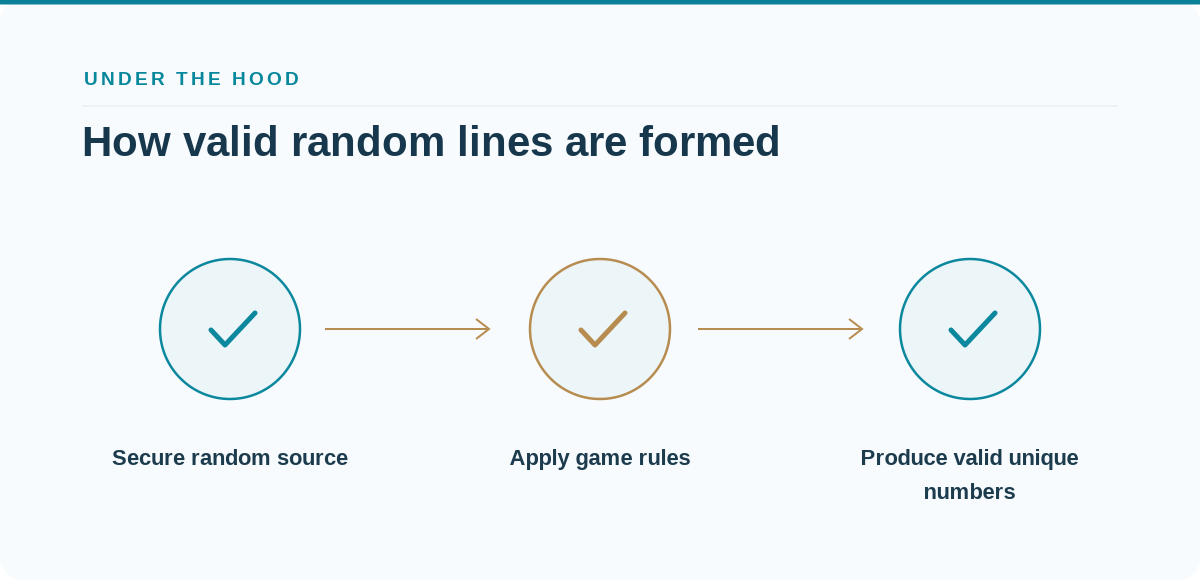
Software can mimic the selection structure by maintaining a pool of eligible numbers and choosing without replacement. The crucial difference is that the program obtains its randomness from a digital source rather than physically mixed slips.
A programmer may implement the same idea by shuffling the entire pool and taking the first three values. If the shuffle is unbiased and the input randomness is suitable, all three-number combinations are treated equally.
The visual order in which the chosen slips are arranged afterwards doesn't matter for an unordered game. But if the actual lottery makes ordered digits meaningful, the selection algorithm and probability model must respect that different rule. A responsible explanation always begins by specifying which kind of game is being modelled.
The difference between uniform selection and preferences
If you request only lines containing three odd numbers and three even numbers, the generator no longer samples uniformly from all permitted six-number combinations. It is choosing from a restricted subset, which is exactly what the filter requests.
That does not mean there is anything wrong with the feature. It means it should be labelled honestly. Personal preferences are design choices, not probability advantages over the official draw.
Why sorting the balls isn't cheating
Suppose a generator chooses the values 52, 8, 31, 4, 27 and 46 in that order, then displays them as 4, 8, 27, 31, 46, 52. The final line might appear suspiciously organised, but the selection itself is unchanged. When a game's combinations are unordered, sorting for display is a perfectly ordinary usability feature.
What would change the selection is discarding a randomly chosen line because it looks odd and generating another until the output passes an aesthetic test. That introduces an additional filter. Again, a filter can be an optional user preference, but it is no longer identical to unrestricted selection.
Another technical detail is replacement. If the algorithm selects a ball and immediately returns it to the pool, it can produce duplicates. Some products allow that; standard pick-six lottery formats generally do not. A reliable generator should implement the game-specific rule deliberately, rather than hoping duplicates do not occur.
These are the small engineering decisions that separate a trustworthy tool from an attractive button with poor mathematics behind it.
Why “random-looking” is not a technical test
A generator can produce tidy-looking outputs and still be biased. For example, simply taking a random byte and using its remainder after division by 59 can make some outcomes slightly more likely if the implementation does not reject surplus values. A carefully designed secure-random algorithm handles this mapping deliberately. The underlying quality of the random source and the number-mapping method are separate questions.
How to assess the finished output
A useful sanity check is to generate many lines in a controlled test and inspect whether values are within range, duplicates are handled correctly and the frequency distribution contains obvious errors. Statistical tests may reveal a defect, but even a clean-looking sample cannot prove perfect unpredictability or certify a particular lottery operator.
LottoLuma explains its secure-random mode in the FAQ and methods page. For an accessible starting point, try the general random-number tool and compare its different modes.
The important result is not that the numbers look random. A sequence of consecutive balls can be perfectly legitimate. The important result is that the software selects within the correct rules, with a sound method, and without suggesting it can influence the real drawing.
Sources and further reading
- MDN Web Docs — Crypto.getRandomValues()
- NIST — random bit generation standards
- LottoLuma — FAQ and number selection methods
Reference links support the article's factual and technical framework. Verify the current game version and editorial wording again before publication.