



Someone who follows UK Lotto, EuroMillions and US Powerball might reasonably ask for one tool that can generate numbers for all three. It sounds simple until you examine the ticket formats. The games are related, but they do not ask you to make the same kind of choice.
A multi-lottery generator is useful when it adjusts to each game's rules. It cannot improve the odds by moving between games.
The pools aren't interchangeable
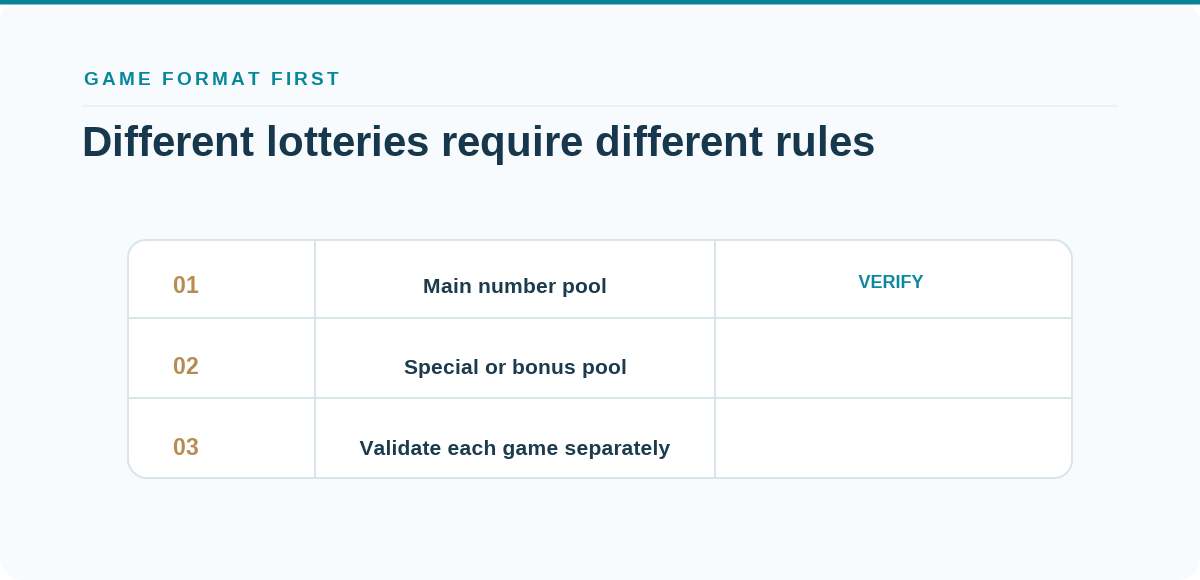
UK Lotto asks for six numbers from 59. EuroMillions combines five main numbers from 50 with two Lucky Stars from 12. Powerball combines five white balls from 69 with one red Powerball from 26.
A tool that produces six ordinary numbers and labels the result “universal lottery line” is not adequate. The distinction between main and special pools is part of the rules, and special balls may have their own probabilities.

The same number can play different roles
Number 11 might be a main ball in one game and a valid special ball in another. A set that looks familiar may be unusable or incomplete when transferred between formats.
Game-specific generators save you from having to keep every format in your head. The appropriate output should make the two groups visually distinct and explain how many numbers each requires.
Time zones are part of the international experience
A game may be associated with a country different from the reader's own. A published draw time in the operator's local time zone does not automatically correspond to the same calendar date elsewhere.
A directory that displays schedules should label its time zone and make clear that purchasing cut-off times can differ from the actual drawing. An independent number-selection tool should never imply that generating numbers before a displayed draw time means an official ticket was submitted.
There may also be country-specific restrictions on buying tickets, claiming prizes and joining supplementary games. Those conditions belong to the official operator's current rules.
This is why a global lottery directory is more than a list of flags: clear geography, timing and eligibility descriptions help prevent genuine misunderstandings.
What about generating several games at once?
For an educational comparison, you can create example lines for different lotteries side by side. This is useful for learning their differences and examining how different combination counts produce different odds.
It is not a shortcut to a profitable strategy. Participating in additional games creates additional potential spending, and there is no evidence that changing lotteries or cycling numbers makes any one entry more likely to win.
Also distinguish number generation from ticket eligibility. A website can display a game's selection format regardless of where a visitor lives. That does not mean the visitor can legally buy an official ticket in their country. National operators control their own eligibility, purchase and claiming rules.
An easy three-game comparison exercise
Write three column headings: UK Lotto, EuroMillions and Powerball. Under each, record the number of main-ball picks and whether there is a separate special pool. The differences are immediately visible: six of 59, five of 50 plus two Lucky Stars, and five of 69 plus one red Powerball.
Now ask a generator to create one example line for each. A correct system should label the individual pools and prevent values outside the relevant ranges. A generic one-size-fits-all app will struggle to explain why its “six lucky numbers” cannot be used everywhere.
Finally, compare the published jackpot event for each game. These probabilities are properties of different game formats, not a ranking of generator quality.
That is a useful way to learn how international lotteries work without purchasing any ticket and without imagining that moving across borders turns one random combination into a stronger one.
A two-game format check
EuroMillions requires five main numbers plus two Lucky Stars, whereas US Powerball requires five white-ball numbers plus one Powerball. A generator that returns a plain seven-number list for both is hiding a critical distinction: the special pools have separate ranges and matching rules. Clear labels for each pool are more valuable than an elaborate “lucky number” display.
A practical international comparison
Start by recording five facts for each game: the number of main balls, the main-number range, any special-ball requirements, the meaning of a standard entry and the operator's current prize rules.
Then compare probabilities separately from prices or prize sizes. A game with a larger advertised jackpot may have much longer jackpot odds. “Best” is not a universal mathematical ranking — it depends on what question you are asking.
LottoLuma's international game directory, format comparison and probability explorer offer three ways to approach this exercise.
A genuinely international generator earns its usefulness by understanding the differences, not by pretending every lottery is the same six-number game.
Sources and further reading
- Irish National Lottery — EuroMillions game information
- Powerball — official prize and odds chart
- Allwyn UK — June 2026 Lotto game changes
- LottoLuma — compare lottery formats
Reference links support the article's factual and technical framework. Verify the current game version and editorial wording again before publication.