



Number generators are excellent at one task: creating selections from clearly defined number pools. The closer a game follows that structure, the more natural a generator becomes. That does not mean generators improve the chances of winning particular games.
Draw-based games are the obvious fit
A traditional pick-six lottery lends itself neatly to a generator. There is a known pool, a fixed number of selections and a rule against repeating the same main number within a standard line.
Games with separate special balls also work well when the software understands the format. EuroMillions has Lucky Stars; Powerball has a separate red-ball pool. An appropriate generator creates and labels each part independently.
This is an important reason to use a game-specific tool instead of a generic “six lucky numbers” app.

Multiple-format lotteries need more care
Some operators provide supplementary options, separate draws, extra numbers or product-specific prize mechanics. A generator may reproduce the standard number-selection portion without representing everything printed on an official ticket.
If you use a tool for educational planning, check what it actually produces. LottoLuma's FAQ explicitly notes that not every supplementary draw ball, assigned digit or additional prize mechanic is represented by every number studio.
A valid-looking row is not necessarily a complete description of every feature in a lottery product.
How to test a generator against an unfamiliar game
Suppose you discover a lottery on the opposite side of the world. Before asking a generator for numbers, find the official operator's current game instructions. Identify every number pool and whether the ticket contains other automatically assigned elements.
Now generate one example selection and compare it field by field. Are there the correct number of main choices? Is every special number inside its permitted pool? Does the website inadvertently duplicate numbers within a pool that requires distinct values?
If the selection looks correct, you have established basic format compatibility. You have not established that the third-party site handles purchasing, eligibility, ticket registration or prize claims.
That deliberately limited conclusion is precisely what a trustworthy product review should reach. Valid-number generation is useful; it is not an endorsement or a guarantee.
Scratchcards are a different category
A scratchcard typically does not ask the player to select a combination for a future draw. Instead, the game's outcome is embedded or predetermined according to that product's approved design and rules.
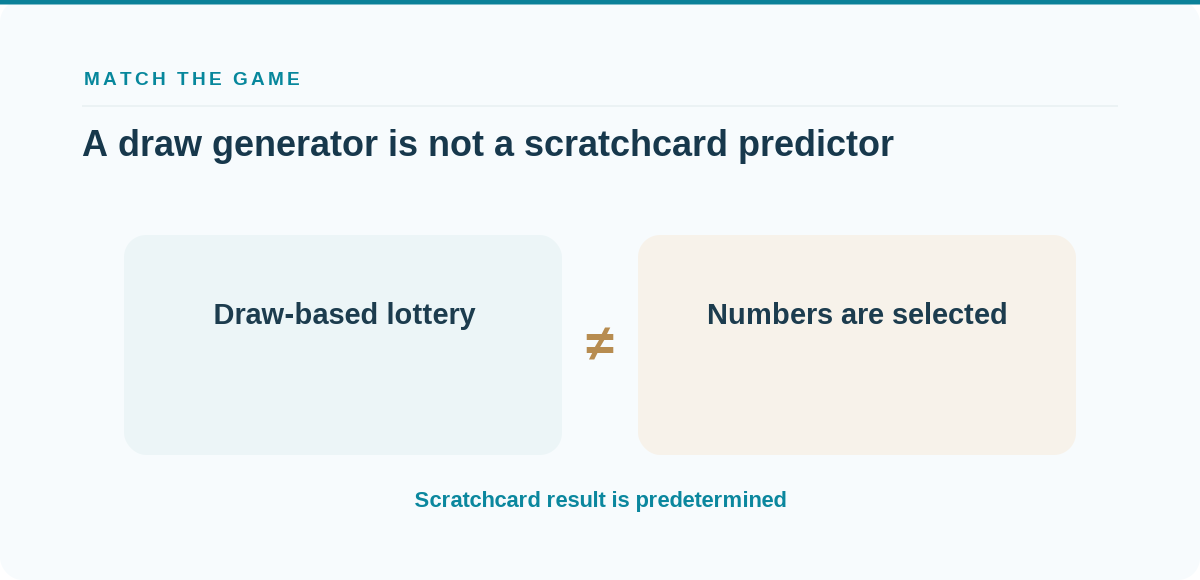
Producing six random numbers on a website will not change the symbols concealed beneath a scratchcard's coating. The Irish National Lottery explains that instant-win outcomes are predetermined; strategy and skill do not affect those outcomes.
That makes conventional number generators irrelevant to the basic mechanics of scratch-off games.
When a generator is the wrong tool entirely
Some products ask players to choose an ordered sequence of digits. Others require a certain arrangement of match conditions rather than an unordered set of balls. The correct generator must reflect those mechanics: order can matter in one product and not in another.
A standard “choose six distinct numbers” interface is therefore not necessarily appropriate for every game using numbers. More fundamentally, instant-win games usually do not let the player define a future draw combination at all.
The appropriate question is not whether the game happens to contain numbers, but whether the player's choice determines a valid entry in the way the generator is designed to represent.
It is also important to note that a number generator cannot validate local age or residency requirements for purchasing a game. Tool compatibility and legal eligibility are separate.
Check whether you actually choose the numbers
For draw games, players commonly choose a combination from published pools. On a scratchcard, the prize outcome is normally associated with a preprinted ticket rather than a user-selected line. A number generator helps with the former task; it has no mechanism for changing the printed result of the latter. That distinction is more useful than ranking all lottery products under one heading.
Compare usefulness, not jackpot promises
A number generator is particularly useful when a game has numerous eligible combinations, an unfamiliar special-ball system or a need to create several examples for a demonstration.
The number of combinations affects jackpot probability; convenience depends on how well the tool matches the rules and how clearly it displays the result.
Use LottoLuma's lottery directory to compare supported draw formats and its format comparison tool to see differences side by side. For the odds themselves, use the probability explorer.
The right question isn't “Which game can a generator beat?” It's “Which game's selection rules can this generator explain and handle correctly?”
Sources and further reading
- Irish National Lottery — EuroMillions game information
- Powerball — official prize and odds chart
- Irish National Lottery — know the odds
- LottoLuma — FAQ and number selection methods
Reference links support the article's factual and technical framework. Verify the current game version and editorial wording again before publication.