



A visitor in Northern Ireland might recognise EuroMillions and UK Lotto immediately, but what about Japanese Loto 7, Brazil's Lotofácil or Australia's Oz Lotto? A global lottery website needs to do more than translate a familiar six-number game into dozens of languages.
International coverage is only useful if the individual game formats remain accurate.
Why “worldwide” is a demanding promise
Different lotteries have different pool sizes, draw structures, special balls and sometimes quite unusual prize divisions. They also change their rules at different times.
A global generator should maintain a separate configuration for each game, ideally supported by an official operator reference and a review date. Reusing a single default number range would be easy to build and easy to get wrong.
There is another issue: lottery names are not always unique. A game called “Lotto” in one country may have little in common with “Lotto” elsewhere. Countries, operators and game identifiers need to be explicit.

Number selection is not international ticket access
Being able to view or generate numbers for an overseas lottery does not mean you are eligible to purchase its official tickets. Buying rules, age restrictions, residency or physical-location requirements and prize-claim procedures depend on the specific operator and jurisdiction.
LottoLuma is an independent information and number-selection site. It does not sell official lottery tickets or administer official draws. Its international pages are tools and explanations, not a substitute for the relevant operator's rules.
Why the same country may need several tools
Countries often run more than one draw-based lottery. A visitor searching for a country name might encounter a traditional pick-six game, a separate multi-pool jackpot game and a shorter daily-number product.
Grouping these under one national heading is useful navigation, but the generator for each must still preserve its own format and terminology. Otherwise a user can choose the right country and the wrong game.
A good directory therefore needs an exact game title and a recognisable description beside the flag. It should make the distinction between a national game, a regional game and a cross-border product visible.
That is a more meaningful mark of international expertise than simply claiming support for a large number of countries.
A useful comparison takes five minutes
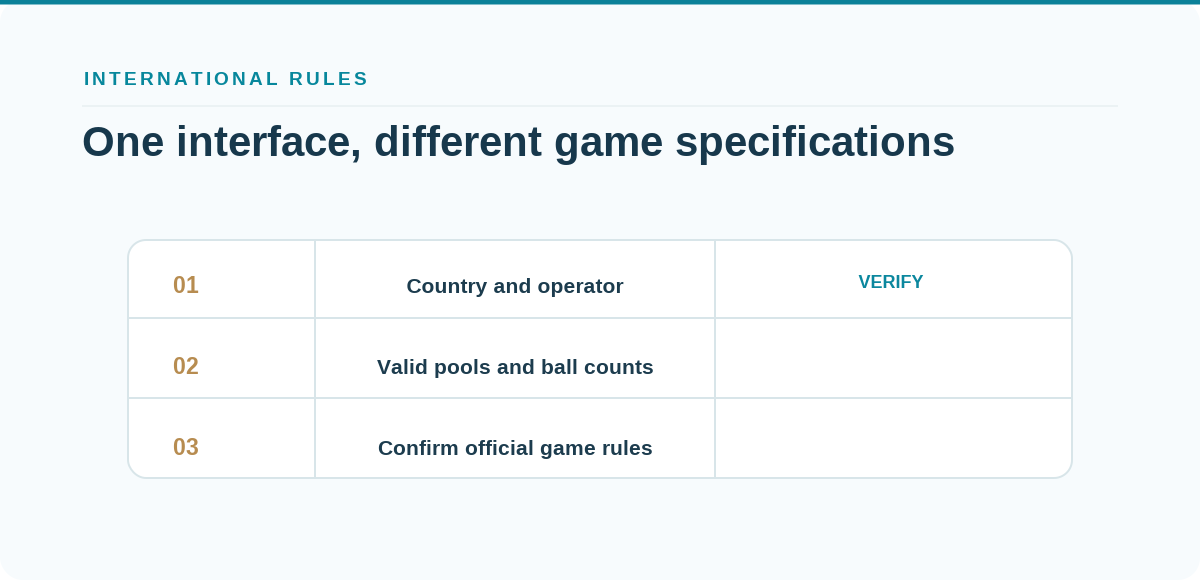
Choose two games from different countries. Write down their standard main-ball pool, special-ball pool if applicable, number of balls selected, draw schedule and published jackpot probability. You may find that two games with similarly named products actually have very different odds.
That is an educational use for a global lottery directory. It helps readers understand differences instead of assuming every national lottery offers the same kind of entry.
The hidden editorial work behind 46 game studios
A truly international number website must maintain an accurate catalogue: game names, region labels, main and special pools, official reference links and updates when rules change. The visible generator is only the last step in that process.
For example, a European cross-border game may be available in several countries, yet it is still one underlying game format rather than several unrelated national games. Conversely, two games with “Lotto” in the name may have entirely different selection rules.
A strong directory should let readers find a game by country without implying that every visitor is eligible to purchase a ticket in that market. Eligibility belongs to the operator's current terms.
Good information architecture is therefore not just a search-engine issue. It is part of preventing misunderstanding about what the numbers represent.
International tools do not create ticket eligibility
A website may help you generate a technically valid combination for a lottery overseas. That is different from being eligible to enter, buy a ticket or claim a prize in that jurisdiction. Operators can restrict sales by age, location and ticket channel. Always distinguish the educational tool from the official rules governing participation.
Design details that make a global tool trustworthy
Correct country names and flags are only the beginning. A good site should clarify regional games, acknowledge cross-border products such as EuroMillions, identify game-rule sources and explain any number-generation settings that are not part of a standard operator entry.
It should also separate local time from the time of the draw. If schedules are displayed, they should use clearly marked time zones, and visitors should verify cut-off times with the official operator.
LottoLuma's all-games directory, lottery comparison and draw calendar provide a practical way to explore these differences.
The value of an international generator isn't that it predicts numbers in more countries. It is that it takes the rules of each country seriously.
Sources and further reading
- LottoLuma — all games by country
- LottoLuma — compare lottery formats
- Allwyn UK — June 2026 Lotto game changes
Reference links support the article's factual and technical framework. Verify the current game version and editorial wording again before publication.