



Lottery odds sometimes arrive as a number so large that it feels meaningless. One in 139 million. One in 292 million. What can you really do with a denominator that wouldn't fit on a typical household shopping list?
You can start with a much smaller game and build the idea step by step.
Begin with a three-ball example
Imagine a toy lottery containing five numbered balls. You select two different numbers, and the game draws two without replacement. How many distinct unordered combinations exist?
There are ten: (1,2), (1,3), (1,4), (1,5), (2,3), (2,4), (2,5), (3,4), (3,5) and (4,5).
If the drawing is fair, each specific pair has a one-in-ten chance. Picking your pair by hand or with a generator does not alter that.
The formula behind the example
The combination formula is C(n, k) = n! / (k!(n-k)!), where n is the pool size and k is the number selected. The exclamation mark represents a factorial, meaning multiplication by each positive integer down to one.
For five choose two, that becomes 5! / (2! × 3!) = 10. For 59 choose six, it becomes 45,057,474.
The crucial assumption is that the order of the chosen numbers does not create a different combination. If a game treats order as meaningful, its calculation is different.
What happens with a separate bonus pool?
In EuroMillions, you select five main numbers from 50 and two Lucky Stars from a separate pool of 12. There are C(50,5) ways to choose the main set and C(12,2) ways to choose the stars.
Multiply the two counts and you obtain 139,838,160 valid full combinations, corresponding to the published jackpot odds.
The separation of pools matters; it is not merely a decorative difference on the ticket.
A probability of zero is not the same as a very small chance
In a standard six-from-59 draw, the exact combination 1, 2, 3, 4, 5 and 6 is unlikely in a single round, but it is valid and has a non-zero probability. A line containing 60 is not a valid standard six-from-59 line at all.
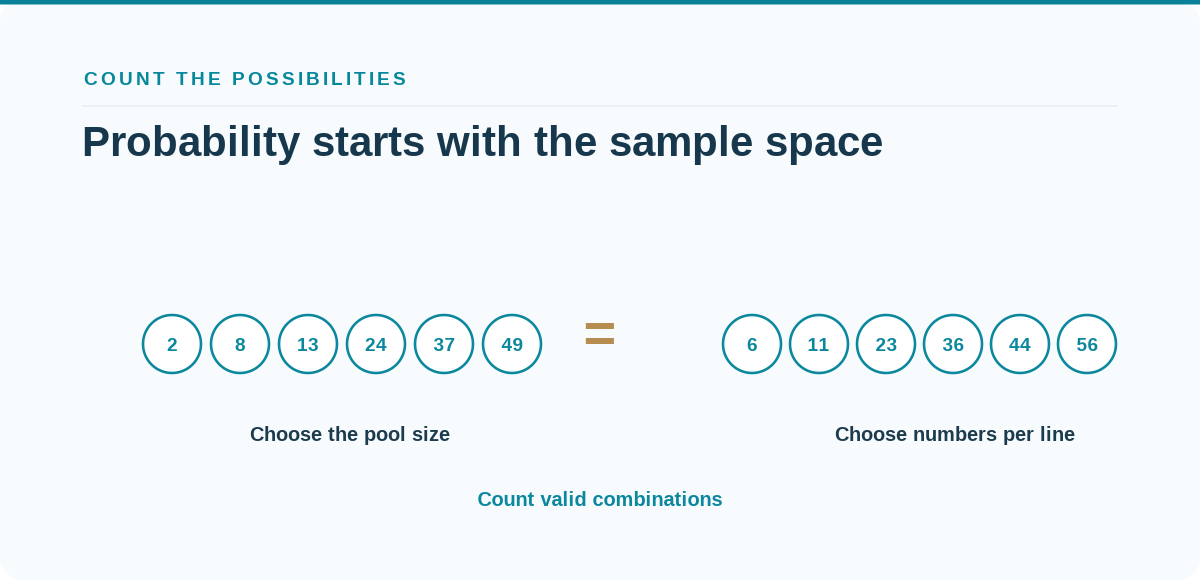
This contrast helps explain why generator accuracy matters. A tool that produces unusual valid combinations may be functioning properly. A tool that outputs invalid numbers has made a format error, not discovered an exceptionally rare result.
Good probability explanations always establish the possible outcome space before discussing the likelihood of any particular event.
What if the entry gets two rounds?
UK Lotto's June 2026 format introduced two rounds for a standard entry. The single-round exact-six probability remains one in 45,057,474; the published per-entry chance across the two rounds is approximately one in 22,528,738.
This shows why a probability question must specify the event precisely. “Chance per round” and “chance per entry across two rounds” are not synonyms.
Why a one-in-ten event can still miss ten times
Return to the toy game with ten equally likely full combinations. If you choose one fixed combination for a single fair round, the chance of matching is 10%.
Across ten independent rounds, the chance of never matching is (9/10)^10, or about 34.9%. Even after ten opportunities, a complete miss is far from impossible.
This is why a probability is not a schedule. A one-in-ten event is not guaranteed to happen exactly once in every ten attempts. The larger the lottery's combination pool, the more important it is to understand that distinction.
The mathematics offers clarity, not certainty. It explains what outcomes are possible and how likely they are under stated assumptions. It does not provide a timetable for a particular person's win.
Combination counting without mystique
In a six-from-59 game, the order in which the six main balls are drawn is irrelevant to an exact six-number match. The number of distinct combinations is “59 choose 6”, written C(59,6) = 45,057,474. This explains the one-round jackpot probability for a specific six-number line. Some games have multiple rounds or special pools, which change the event you are calculating.
The lesson that applies to every line
A generator can create valid choices. It cannot influence which permitted combination the official system selects. And a probability of one in a very large number is never a guarantee, even if you buy multiple entries.
LottoLuma's lottery odds explorer offers a way to explore these calculations using real game formats. Mathematics will not predict your ticket, but it can protect you from misleading claims about it.
Sources and further reading
- Irish National Lottery — EuroMillions game information
- Powerball — official prize and odds chart
- Allwyn UK — June 2026 Lotto game changes
- LottoLuma — probability explorer
Reference links support the article's factual and technical framework. Verify the current game version and editorial wording again before publication.