



Imagine three adverts displaying three enormous jackpots. It is tempting to line them up by prize value and choose the biggest number. Yet the mathematics of the underlying games can differ substantially. Comparing lotteries fairly means looking at what combination wins, how many outcomes are possible and what the advertised odds actually describe.
Start with the correct jackpot event
A simple single-round six-from-59 game has 45,057,474 possible unordered six-number combinations. One exact match corresponds to one in that many outcomes.
EuroMillions uses five main numbers from 50 and two Lucky Stars from 12, making 139,838,160 possible full combinations. Its official jackpot chance is one in 139,838,160.
Powerball uses five white balls from 69 and a red Powerball from 26, with published grand-prize odds of one in 292,201,338.
These are probabilities of the specified top-prize match, not the chance of receiving any smaller prize.
UK Lotto now needs an extra explanation
Since June 2026, a standard UK Lotto entry participates in two rounds. The chance of a six-number match within any one round remains one in 45,057,474, while the officially published jackpot chance for the entry across the two rounds is approximately one in 22,528,738.
That is why a trustworthy comparison needs a date and a precise definition of “per draw”, “per round” and “per entry”. An old odds table may be arithmetically correct for a historical format and wrong for the current one.
Why you should never compare odds without the date
A probability table can become outdated even when the mathematics was correct when it was written. Operators can alter number ranges, introduce additional rounds or revise the conditions of an entry.
UK Lotto's 2026 format illustrates this vividly. A historical one-in-45,057,474 figure still describes a single exact-six round, but it no longer fully describes the current standard entry's two-round jackpot chance.
The safest comparison format includes a review date and a link to the operator's current rules. When a rule changes, the article should be updated transparently rather than quietly rewriting history.
That attention to versioning is a hallmark of useful lottery journalism.
Higher odds of any prize are not necessarily better value
A game may have many low-tier prizes, increasing the overall frequency of receiving something, while keeping its jackpot highly unlikely. That does not tell you whether an average ticket produces a positive financial return.
To evaluate financial value, you would need reliable prize distributions, ticket costs and rules for jackpots and sharing. Those vary between games and may change. A simple jackpot probability comparison is not a recommendation to purchase a particular game.
A denominator is not a promise
When comparing one in 22.5 million with one in 292.2 million, remember that you are comparing specific defined jackpot events in different games. You are not proving that buying one game offers better personal financial outcomes, and you are not accounting for all lower prize categories or ticket costs.
The same caution applies to prizes advertised in different currencies and to jackpots with different payout mechanisms. A headline amount might describe an annuity, while another may be advertised as a cash equivalent. Those details require separate, current operator evidence.
A good comparison therefore has two layers: mathematical odds under each game's stated rules, and factual product information such as price, eligibility and payout terms. Mixing the layers carelessly produces a compelling but unreliable ranking.
Compare like with like
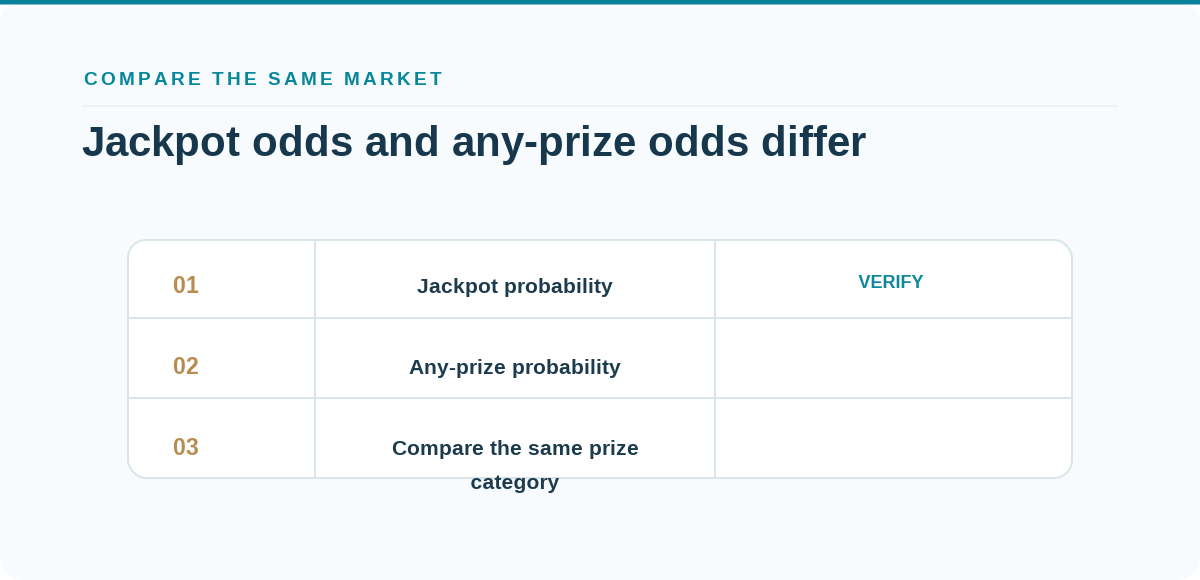
A headline jackpot probability answers a different question from the chance of receiving any prize. Two games may have different prize tiers, ticket prices and draw frequencies even when their jackpot figures look comparable. For a meaningful comparison, label every column with the exact event being measured and the applicable version of the game rules.
What a responsible comparison table should show
Include the game and operator, version date, main-number pool, special-ball pool, definition of the entry, jackpot odds, overall odds if verified, ticket price if current and jurisdiction, and official rules source.
Do not automatically turn the smallest denominator into “the best lottery”. Probability is one feature; rules, eligibility and personal choices are separate matters.
LottoLuma's compare-lotteries page, international directory and probability explorer help organise the information.
The best comparison is the one that makes you understand what the numbers mean — not the one that promises one country has discovered an easier path to a jackpot.
Sources and further reading
- Powerball — official prize and odds chart
- Irish National Lottery — EuroMillions game information
- Allwyn UK — June 2026 Lotto game changes
- LottoLuma — compare lottery formats
Reference links support the article's factual and technical framework. Verify the current game version and editorial wording again before publication.