



A generator can produce ten lines in seconds. With the right code it could produce thousands. That speed raises an awkward question: how many do you actually need?
There is no lucky quantity of generated lines. The right number depends on whether you are experimenting with probability, organising a list or considering actual lottery participation. The number of lines you can generate is not a recommendation about how many tickets to buy.
One line is already a complete selection
For a standard six-from-59 format, one valid line represents one of 45,057,474 possible unordered six-number combinations in a single fair round.
If you generate five distinct lines, your list represents five different combinations. If you generate five identical lines, it represents only one distinct combination. Neither result creates an advantage for an individual line.
In an educational experiment, generating more lines can help illustrate probability, duplicates and the shape of a random sample without involving money at all.

More entries change coverage and spending
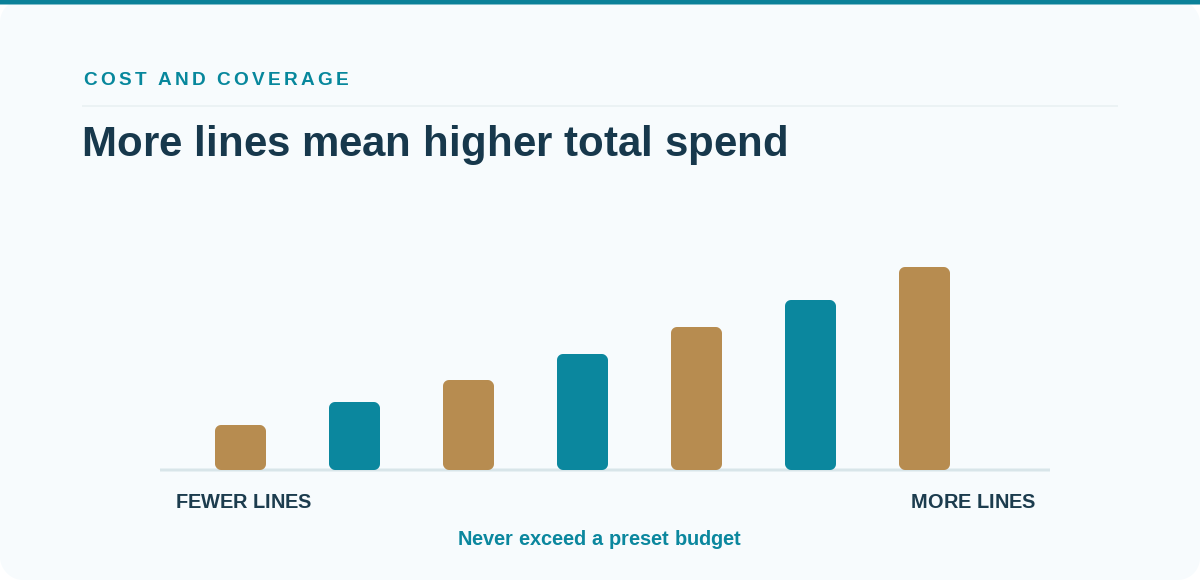
If someone purchases multiple distinct official entries for the same single-round lottery, the collection covers more possible winning combinations than one entry. The combined chance of at least one exact jackpot match in that single round is k/N for k different combinations out of N equally likely possibilities, provided the event and game structure match those assumptions.
This is a counting relationship, not a financial strategy. Ticket costs rise with entries, and most major-lottery jackpots remain extremely unlikely even with many lines.
Be careful applying that simple formula to games with two rounds per entry, supplementary mechanics or prize categories with different rules. UK Lotto's current two-round format requires separate treatment from a single independent round.
Do several lines need to come from different methods?
No mathematical rule requires a collection of examples to mix manual, random and history-based selections. If you are comparing methods for research, create separate clearly labelled groups so you can evaluate what each method produces.
If you are simply generating a few valid lines for reference, the choice of method is a matter of preference and tool functionality. A mixture of methods does not make the official draw more favourable.
The main limitation is practical: more lines can make the results harder to organise, and purchasing more entries increases costs. When a website suggests generating extra lines, it should distinguish a free demonstration from advice to spend money.
In most everyday cases, clarity is more valuable than quantity.
A budget should be chosen before a line count
If participation is part of your entertainment, decide what amount you can comfortably afford to lose. Do not reverse-engineer an increasingly large budget from a generator's ability to produce more lines.
Generating numbers to study them costs nothing in itself. Buying tickets is a separate decision with real-world consequences.
Why a million generated lines can still mislead
A computer can enumerate enormous collections of possible selections without buying any tickets. In a six-from-59 model, there are more than 45 million distinct full combinations. Displaying thousands of lines may look impressive but remains a tiny fraction of that space.
If an educational sample is large enough, you can inspect distribution patterns and duplicates. If your purpose is merely to choose a valid personal example, a huge batch adds almost no practical value.
It is also easy to confuse the chance of a particular line with the chance of some line somewhere in a large generated set. The latter depends on the number of distinct combinations, but no free generator makes those entries official.
This is why the correct “how many?” question begins with what you are trying to do, not with the maximum button value in a settings panel.
More lines means more cost, not magic
For a fair one-round game with N distinct jackpot combinations, k different lines represent k possible outcomes and have jackpot-hit probability k/N, provided k does not exceed N. That arithmetic does not determine whether buying k lines is sensible. Decide on an affordable limit before generating lines; the price and your personal budget matter far more than any “optimal” number suggested by a website.
A practical number for a demonstration
Five to ten lines are often enough to compare manual versus random selections visually. A larger sample may be useful for classroom statistics, but if your aim is to test the properties of a random-number algorithm, you need an explicit methodology rather than an arbitrary screenshot of outputs.
LottoLuma's random-number tool and probability explorer make it possible to examine the distinction between sample size and mathematical odds.
The best quantity is the smallest one that accomplishes the task. If the task is simply choosing a line you like, one can be enough.
Sources and further reading
Reference links support the article's factual and technical framework. Verify the current game version and editorial wording again before publication.