



There is a romantic idea that seasoned lottery players possess a clever formula they never quite reveal. Perhaps they know which patterns to avoid, how to follow the hot numbers or when the machine is ready to produce a jackpot. The reality is more prosaic — and much more interesting.
Experience does not give a player control over a fair random draw. It can, however, make someone better at understanding the rules, handling tickets, recognising misleading claims and setting sensible limits.
The expert habit that matters most is reading the rules
An experienced player knows the difference between matching six numbers in one UK Lotto round and the current two-round chance associated with a standard UK Lotto entry. They know that Powerball's red ball is a separate pool, not simply a sixth white ball. They also distinguish jackpot odds from overall odds of winning any prize.
These details don't make any one selection luckier. They prevent misunderstandings about what a ticket actually represents.

Why personal rituals persist
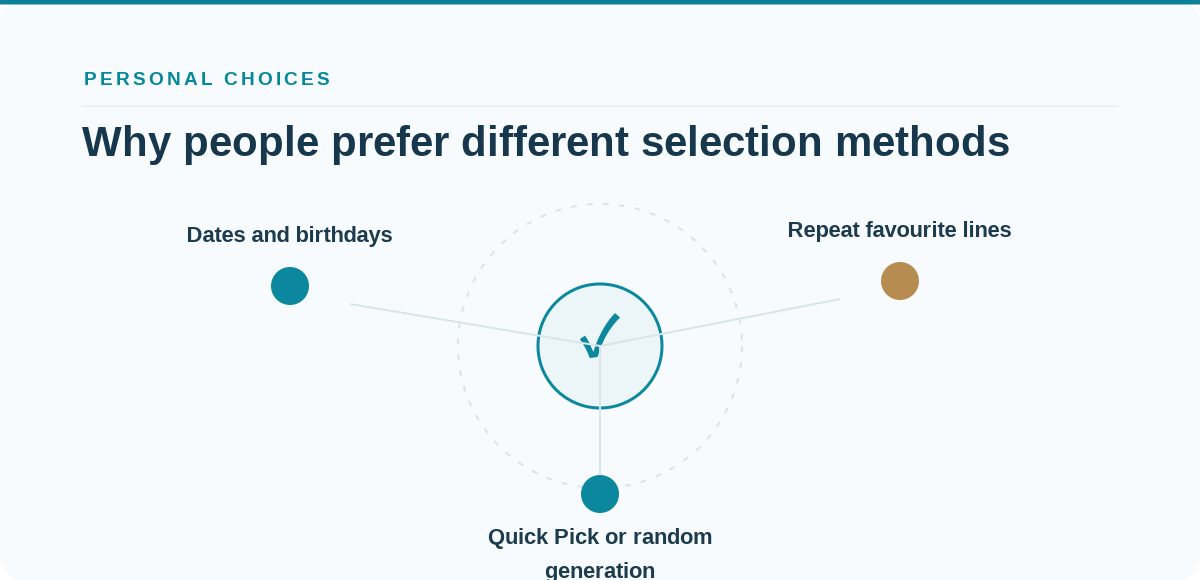
Some people keep the same numbers for decades; others change them every draw. A familiar sequence can feel like a personal tradition, and a new combination can make a draw feel fresh. Neither ritual is a statistical method that changes the fair draw's probabilities.
Players sometimes use balanced numbers, avoid obvious dates or include meaningful values. Those decisions influence which combinations they choose, not the probability of any chosen combination being drawn.
In games where jackpots are shared, another player's choices may affect the prize share you receive in the event of a win. But an uncommon-looking line is not guaranteed to be unique, and avoiding popular combinations does not improve the chance that yours wins.
Consider a careful budget, not a clever system
The most useful habit a knowledgeable participant can develop is deciding how much, if anything, to spend before entering. A lottery ticket is a chance-based entertainment purchase, not a repeatable source of income.
The mathematics can make this easier to see. In a game with a very large combination pool, buying a second distinct line increases the number of covered combinations but also increases expenditure. That is not a mathematical loophole. Buying more tickets to recover earlier losses compounds the cost, not the predictive power of the method.
A “system” can be well organised and still have no predictive power
Someone may use a spreadsheet to prepare a series of lines with particular coverage rules. That can be an impressive organisational achievement. If the coverage is described precisely, the mathematics may be entirely correct.
But a correctly calculated system should state exactly what it does. Does it ensure distinct combinations? Does it guarantee certain lower-tier matches conditional on a specified set of numbers appearing? Does it require a particular number of purchased entries?
These are meaningful claims that need careful assumptions. None establishes that the official draw is more likely to favour those entries than any equally sized set of valid combinations.
The expertise worth learning from is the willingness to explain conditions and costs, not the promise that enough arithmetic will make a random machine predictable.
What experienced researchers do differently
A statistically literate researcher asks whether an apparent pattern would still look impressive if the data had been selected in advance, whether the game rules changed during the sample and whether a claimed strategy beat an honest random baseline in out-of-sample tests.
Those questions are more useful than memorising last week's most frequent numbers. LottoLuma's probability explorer and methodology page can support that kind of curiosity.
Three questions a careful player can answer
Before using any supposedly advanced selection technique, ask whether it changes the set of lines I choose, the cost of the entries, or the actual probability mechanism of the official draw. Most strategies change the first, some change the second, and ordinary player-selected number systems do not change the third.
This framework is especially helpful when someone advertises a wheeling system. A wheel is a way of arranging or covering combinations according to defined rules; the resulting number of purchased entries and matching guarantees under particular conditions must be examined carefully. It is not a magical override of a fair lottery's probabilities.
The same goes for an elaborate notebook full of frequency charts. It may be a meaningful hobby and a good way to learn statistics. It does not become a proven edge simply because it took many hours to produce.
Practical expertise should make a person more sceptical of certainty, not more impressed by the appearance of complexity.
What expertise can and cannot change
Experience can improve record-keeping, understanding of rules and the ability to notice a misleading claim. It cannot turn a valid six-number combination into one that a fair draw is obliged to favour. If someone describes themselves as a professional lottery selector, ask whether their claims refer to genuine probability, prize-sharing decisions or simply their personal method.
Be cautious with the phrase “professional lottery player”
Unlike professional disciplines where skill can reliably influence outcomes, the outcome of a fair lottery draw is designed to be random. Stories about people who win repeatedly deserve careful scrutiny: which games were involved, how many tickets were purchased, whether prizes were shared and what costs were excluded from the story?
A person can be extremely knowledgeable about lotteries without possessing a reliable prediction method. That is the useful definition of expertise here: understanding the boundaries of what anyone can know.
Sources and further reading
- Powerball — official prize and odds chart
- LottoLuma — probability explorer
- LottoLuma — safer lottery participation
Reference links support the article's factual and technical framework. Verify the current game version and editorial wording again before publication.