



A free generator may offer a big button and a perfectly serviceable set of numbers. A paid service might display statistics, advanced filters, export formats and an impressive “AI prediction engine”. It would be easy to assume the paid version has a greater chance of producing a jackpot line.
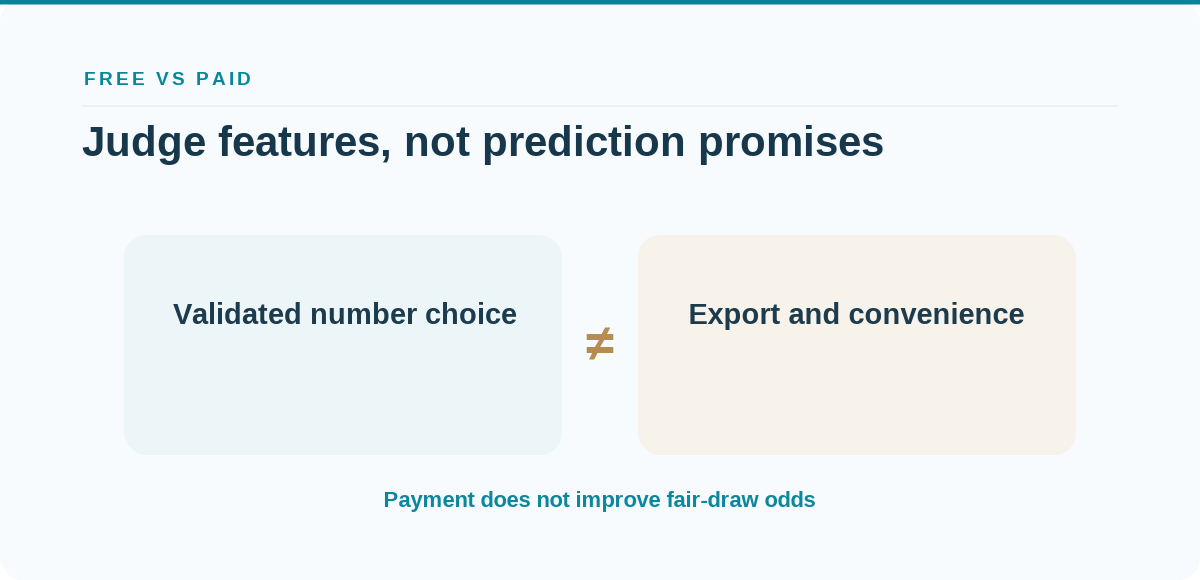
There is no mathematical basis for that assumption. Paying for features does not make a valid combination more likely to appear in a fair draw.
Separate software features from prediction claims
Paid software can genuinely offer useful conveniences: saved lists across devices, advanced reporting, detailed visualisations, structured exports or an interface suited to a particular workflow.
Those may justify a price for somebody who needs the functions. The value comes from the tool's usability and quality, not from control over the lottery machine.
A service charging for “winning forecasts” needs much stronger evidence than an attractive dashboard. Ask how predictions were evaluated, on what unseen dates and against what random baseline.

What a good free option should already handle
A reliable free generator should generate valid combinations, explain the selection method, respect privacy, follow the correct game format and make no claims of guaranteed results.
For a simple “give me one valid random line” task, charging money is not technically necessary. A free tool can perform that task well.
How to compare the true cost of a premium tool
A monthly subscription may look modest, but evaluate what you are paying for over a reasonable period. Does the fee fund a feature you genuinely use, such as cross-device access or a specialised export format? Or does the product mostly repackage basic random selection with dramatic language?
Also consider the portability of your data. If you cancel the service, can you download saved selections or research notes? Are the results stored in a standard format or locked into an account that becomes inaccessible?
These are normal consumer-software questions and far more useful than asking whether the paid version's favourite numbers will be drawn.
Treat any promised financial return from a lottery prediction subscription with particular scepticism.
Subscription costs change the calculation
Suppose a service charges a monthly fee to organise and analyse your numbers. That fee is separate from the cost of any official tickets. Do not mentally subtract the subscription from hoped-for winnings or assume that extra expense increases the likelihood of a prize.
If you enjoy historical research as a hobby, assess the software in the same way you would assess any research application: features, support, accessibility, accuracy and data handling.
How to spot a dressed-up random button
A paid product may show an animated graph, an “optimisation score” and numbers highlighted in green. To evaluate it, ask whether the score measures something concrete, such as how closely a line follows your chosen odd/even preference, or whether it claims to forecast a fair draw.
The first is a valid description of software behaviour. The second requires proper predictive evidence. A complicated interface does not change that distinction.
You can also compare paid and free tools using the same game and task: generate ten valid lines, preserve their formats, identify duplicates and export the results. If both perform the task correctly, the paid service must justify its cost through convenience or genuine additional functionality, not mere decoration.
Avoid subscriptions that rely on pressure, scarcity or suggestions that a near win means the algorithm is close to a breakthrough.
What a paid subscription can reasonably sell
A paid tool may offer storage, collaboration, richer exports or advanced analysis. Those are software features that can be compared. Paying cannot alter the independently conducted official draw, so any subscription justified mainly through superior jackpot odds deserves scepticism. Compare the advertised feature with a real workflow you need, rather than a claimed ability to predict chance.
Ask five questions before paying
What specific feature is unavailable for free? Does it work for my game's current rules? Can I export my records if I stop paying? What happens to my personal data? Does the vendor clearly distinguish historical analysis from prediction?
Answers are more valuable than claims about secret algorithms.
LottoLuma provides free game-specific number studios and a general number generator, with its methods and limitations explained publicly. That makes it a reasonable comparison point for evaluating what another service actually adds.
A paid generator can be worth purchasing as software. It should never be mistaken for a paid route around the mathematics of chance.
Sources and further reading
Reference links support the article's factual and technical framework. Verify the current game version and editorial wording again before publication.