



A screenshot of six numbers may be easy to create and surprisingly difficult to understand a month later. Which game were they for? Was that Wednesday or Saturday? Were the numbers simply generated, or was an official ticket actually purchased?
This is why number tracking deserves its own conversation. Generating a line, recording a line, checking a result and proving a valid ticket purchase are four separate tasks.
What tracking might mean
A basic tool may save your most recent generated combinations within the browser session. Another may allow a download. A more advanced record keeper might store draw dates or let you compare a line against official results.
Do not assume these features are present on every website or every game page. If a site claims automatic cross-draw monitoring, check whether it actually retrieves current official results, what time zones it uses and how it handles operator corrections.
A generator that merely displays numbers cannot truthfully claim to track purchased tickets.

Make a record that will still make sense later
For a simple personal spreadsheet, use columns for game name, generation date, intended draw date, main numbers, special numbers, selection mode and purchase status. Keep the official ticket reference separately and securely if you have actually entered a draw.
This separation prevents a particularly frustrating error: interpreting a line created on a website as proof that you were entered into the corresponding draw.
Game-rule changes complicate old records
Formats evolve. If a game changes its number pool or introduces an extra round, older records may no longer be directly comparable with new ones. Preserve the original game version and draw date when analysing historical selections.
UK Lotto's June 2026 two-round change is an example. A record that merely says “Lotto ticket” without a date can hide meaningful differences in the conditions under which the entry was played.
What does “automatic tracking” really promise?
A tracking service might store a list of saved lines, check published results on a schedule or send notifications when selected matching conditions are met. Those are separate capabilities and should not be treated as one feature.
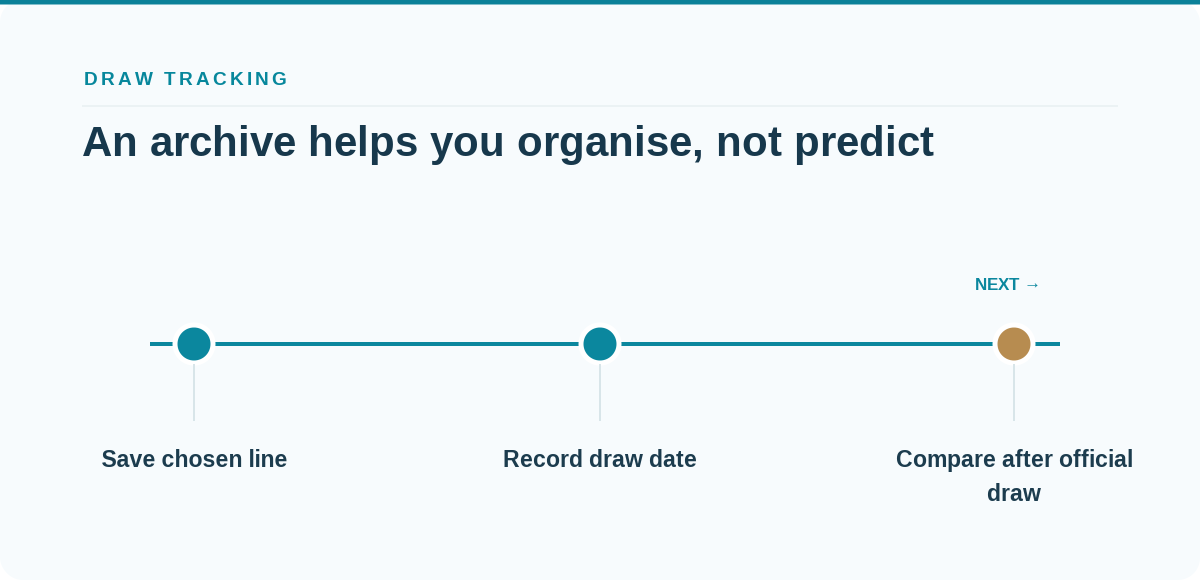
For automatic checking, ask where the results come from, how quickly corrections are reflected and what happens when a game's rules change. For notifications, ask whether the service needs personal contact information and how the user can turn alerts off.
If the tool merely retains selections locally, say so. That can still be useful, but it is not an automatic official ticket tracker.
Accurate feature descriptions are part of reader trust, especially for a website discussing prizes and money.
How to check results properly
Use the operator's official published results and prize rules. If a third-party checker reports a match, verify it against the original source, including separate bonus pools, dates and any supplementary mechanics.
LottoLuma provides draw-history guidance, a draw calendar and game studios with selection and checking-related capabilities that should be verified on each page. These aids do not replace an official ticket record or claim process.
A tracking record can fail in three ordinary ways
First, a user checks the correct numbers against the wrong draw date. Second, a record includes the main numbers but drops the special balls needed to establish a prize tier. Third, an old selection is mistaken for proof of purchase.
These are not sophisticated technical failures. They are failures of labelling and context.
A sensible record includes an explicit status field and enough game information to avoid all three. You should also distinguish a result that was checked from a prize officially confirmed, especially if the operator may amend a published result or has specific claim requirements.
If the tool's tracking feature does not support these distinctions, a simple, carefully maintained spreadsheet may be more reliable than a flashy dashboard.
A history of generated numbers is not a ticket record
A saved line tells you what a tool produced, not whether you entered that line in an official draw. Keep official purchase confirmations separate, with dates, draw identifiers and the ticket holder’s details stored securely. The distinction matters if you later compare a generated list against published results or need evidence for a prize claim.
The privacy angle
Numbers can be harmless entertainment data, but ticket images may contain barcodes, account references or identifying details. Avoid posting them publicly. If using a cloud tracker, understand who can access your records and how long they are retained.
The best tracking system is not the most elaborate one. It is the one that clearly distinguishes choices you made from tickets you actually bought, and preserves enough context to check them accurately.
Sources and further reading
- LottoLuma — draw-history file guide
- LottoLuma — FAQ and number selection methods
- Allwyn UK — June 2026 Lotto game changes
Reference links support the article's factual and technical framework. Verify the current game version and editorial wording again before publication.