



A lottery draw may last only a few minutes. The work needed to make the result trustworthy begins long before the balls start moving or a random-number system produces an outcome.
Draw integrity depends on procedures, controls, independent oversight where required, and accurate public records — not simply on the claim that the result was random.
The lottery operator and the regulator play different roles
The operator runs the game under its rules and licence. The regulator supervises relevant obligations within its jurisdiction. Technical requirements, security standards and disclosure arrangements differ by game and country.
The UK Gambling Commission publishes material on random outcomes, compliance testing and lottery security. The existence of standards does not mean every drawing process or every technical audit report is made public in full; some details are operational or confidential.
What a draw-control system may examine
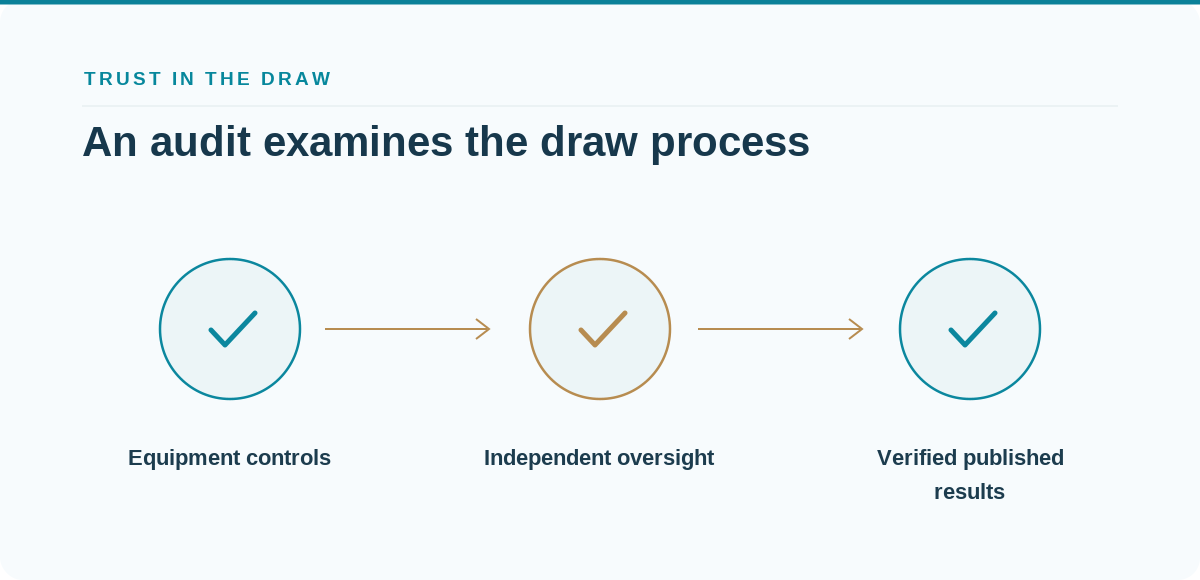
Depending on the lottery and its procedures, important controls can include equipment testing and maintenance, secure handling of physical balls, access restrictions, supervised drawing steps, result recording, system checks and mechanisms for dealing with discrepancies.
A digital drawing method raises different technical concerns, such as the quality and testing of the random-number generator, correct mapping of values to outcomes, change control and safeguarding the software environment.
It would be misleading to claim every national operator uses an identical checklist. The right evidence is the current public documentation for the specific game.
The public may not see every security detail
Some details of operational security, access controls or technical test procedures are deliberately not disclosed in full. Publishing every security mechanism could itself create risks.
That limitation makes source discipline especially important. A writer should describe what an operator or regulator has actually confirmed and acknowledge where the public record ends.
Claims such as “every draw is checked by three independent auditors” require specific evidence for the particular game and date. Without that evidence, generic language about oversight should not be turned into a detailed fictional account.
It is possible to write an informative article about integrity while clearly separating documented controls from general industry concepts.
Random-looking output is not sufficient evidence
A few neat-looking draws tell you little about whether the system is well controlled. Equally, one unusual result is not proof of tampering. A genuine investigation needs verified records, an appropriate statistical model and knowledge of the procedures involved.
Security and fairness are related but distinct: a good mathematical distribution does not guarantee secure operations, and a locked room does not establish statistically fair software.
What to do if you see an unusual draw
A rare-looking result is not, by itself, evidence that a lottery was compromised. Write down the exact game, draw date and official result. Check the operator's published rules and whether any correction notice was issued.
If you find an apparent discrepancy — for example, different numbers reported by two websites — prioritise the official operator and regulator information and contact the appropriate support channel for clarification.
An independent number-selection site should avoid presenting speculation as a verified integrity problem. Similarly, it should not claim to have conducted technical audits unless the actual work and evidence are available.
Trustworthy reporting leaves room for uncertainty while making it possible for readers to check the sources for themselves.
What an audit is meant to establish
Lottery integrity controls may involve equipment inspection, draw procedures, record-keeping and independent oversight. Their purpose is to support fair, traceable operation, not to reveal next week’s numbers. An article about a particular operator should link to that operator’s current published procedures rather than assume all jurisdictions use identical machines or monitoring arrangements.
Where an independent generator belongs
A website that helps users select numbers is not the same as the official draw mechanism. LottoLuma's methods and sources explain its selection processes and sources, not a claim that it conducts national lottery draws.
If you need authoritative information about how a particular operator secures draws, look for its current published procedures and regulator statements.
The most reassuring answer to “who checks?” is not a dramatic declaration that a lottery is impossible to compromise. It is a clear account of the controls in place, who is responsible for them and what evidence is available to verify the claims.
Sources and further reading
- UK Gambling Commission — RTS 7 random outcomes
- UK Gambling Commission — National Lottery integrity information
- LottoLuma — methods, sources and limitations
Reference links support the article's factual and technical framework. Verify the current game version and editorial wording again before publication.