



The science of lottery numbers sits at an interesting crossroads: probability theory, computer engineering, physical systems and human psychology. People often focus on patterns in winning numbers. Engineers and statisticians focus on a different question: was the selection process fair and sufficiently unpredictable?
What “random” means in a lottery context
For a standard draw, randomness does not mean the numbers must look chaotic. It means the permitted outcomes should have the probabilities specified by the game's design, and unintended patterns should not allow a meaningful prediction advantage.
A fair six-from-59 round has 45,057,474 unordered six-number combinations. Every particular combination has the same probability, even if one contains consecutive numbers and another looks pleasingly balanced.

Physical balls and digital algorithms are different systems
A physical drawing machine depends on equipment and procedures designed to prevent predictable bias. The lottery operator's rules, maintenance protocols, security controls and draw verification processes matter.
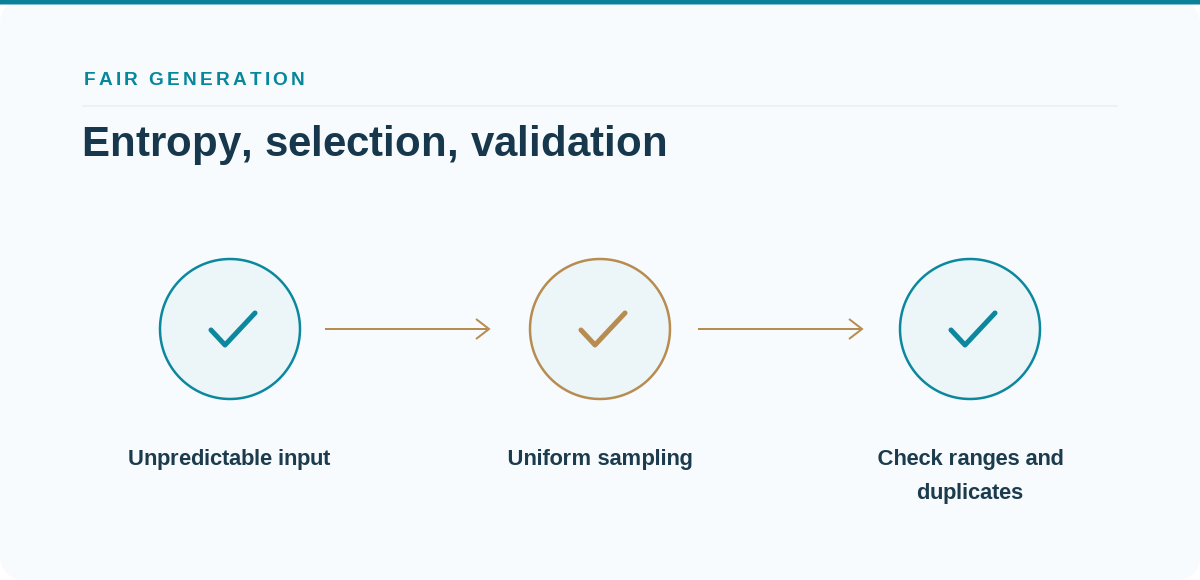
A computer-based random-number system starts with random bits or a randomness source, applies an algorithm and maps the output into valid game results. Standards developed by organisations such as NIST describe ways to generate cryptographically strong random bits and examine related security properties.
Those technical standards concern particular implementations. A public number-selection website cannot call itself a certified official lottery draw merely because it uses a well-regarded browser API.
The combinatorics are wonderfully unforgiving
The number of unordered combinations for selecting k items from a pool of n is written C(n, k), or n! / (k!(n-k)!). You do not multiply by k! again unless the game actually treats different orders as distinct outcomes.
A second special-number pool introduces another combination count. For EuroMillions, the number of five-from-50 main combinations is multiplied by the number of two-from-12 Lucky Star combinations. The total is 139,838,160 valid full selections, matching the official jackpot odds for one line.
An incorrect formula can be as misleading as an incorrect algorithm. It is worth checking each assumption about order, replacement and special pools.
Why physical and computer randomness aren't identical concepts
A physical draw uses real-world movement and equipment. A digital generator uses electronic inputs and computational procedures. Both can be designed so that the relevant outcomes meet a defined probability model, but they need different types of control and verification.
You cannot establish the integrity of a physical draw by pointing to a browser's random-number function. Nor can you evaluate a browser generator solely by watching a video of balls moving in a machine.
The common scientific language is probability: what outcomes are possible, what probabilities should they have, and what evidence supports the claim that the process behaves accordingly?
By asking those questions separately, you avoid confusing the official mechanism that determines prizes with an independent tool that merely proposes numbers before a draw.
The psychology of randomness
People often distrust clusters. A result with several consecutive values looks manufactured, whereas evenly spread numbers feel natural. But restrictions based on appearance change the sample space. A visually neat distribution is not automatically evidence of fair randomness.
This explains why a responsible generator should distinguish its secure-random mode from optional filters that deliberately favour particular-looking lines.
An example that separates design from appearance
Suppose a game requires four different numbers from 1 to 20. You decide a visually balanced line must contain two numbers below 10 and two above 10. That sounds harmless, and it can be a satisfying personal choice.
But it imposes a condition the official drawing does not necessarily have. A fair four-from-20 game can produce four low numbers, four high numbers or any other valid combination. Your filter changes which results your selection process is capable of generating.
This illustrates the scientific point: a generator can be technically correct while implementing a restricted distribution. To evaluate it, you have to understand which distribution it was meant to implement.
In that sense, inspecting code, rules and configuration matters more than merely counting how many outputs look random. If you study lottery statistics, precisely define the mechanism before testing its results.
Three tests that answer different questions
A range test checks whether every output is eligible. A frequency test asks whether some eligible outcomes appear disproportionately often over a suitable sample. An independence test asks whether earlier outputs influence later ones. Passing one test does not establish the others. A generator can be syntactically correct yet biased, or have even overall counts while exhibiting predictable sequences.
A scientific approach to using generators
Begin with accurate game rules, use a sound selection method, verify outputs, and describe exactly which probability is being calculated. If you test randomness, distinguish between detecting an obvious bias and proving a system is universally unpredictable.
LottoLuma's methods page and probability explorer provide a useful introduction. For deeper technical reading, consult the browser documentation for crypto.getRandomValues() and NIST's random-bit generation recommendations.
The science is not about finding the next magic combination. It is about making the process understandable, testable and honest.
Sources and further reading
- MDN Web Docs — Crypto.getRandomValues()
- NIST — random bit generation standards
- UK Gambling Commission — RTS 7 random outcomes
- Irish National Lottery — EuroMillions game information
Reference links support the article's factual and technical framework. Verify the current game version and editorial wording again before publication.