



Lottery myths survive because many sound like common sense. A number has been missing, so it is due. Six consecutive values look impossible, so a spread-out line must be safer. A computer picked most winners, so Quick Pick must have a secret edge.
The appeal is understandable. The mathematics is less cooperative.
Myth 1: A cold number must appear soon
Past absences do not force an eligible number into the next independent fair draw. A long gap is not a debt that probability has to repay.

Myth 2: Consecutive numbers cannot win
A fair game permits combinations containing consecutive values. They may look unusual, but every particular valid full combination has its own equal chance within the format.
Myth 3: Balanced lines are more likely to win
Some categories of odd/even balance contain more distinct combinations than others, but that does not make a specific balanced line more likely than a specific unbalanced line.
Myth 4: Quick Pick is mathematically luckier
Official Powerball information explains that computer-selected numbers account for many winning tickets partly because they account for many purchases. A valid manual line has the same individual draw probability.
Myth 5: Last week's winner cannot recur
An earlier winning combination remains eligible in a fair independent future draw unless the game's rules themselves have changed.
Myth 6: A generator can influence the official machine
A website can prepare a line. It cannot remotely persuade an independent official lottery drawing to produce that line.
How to challenge a lottery claim politely
Instead of arguing about whether somebody's favourite system “feels lucky”, ask what exact probability event the claim concerns. Then ask whether the system was tested on future results with the method fixed in advance.
For example, “This method predicted 12 numbers correctly” needs context: from how many proposed numbers, across how many draws and for which game? Without those details, the claim can be true and still demonstrate nothing about forecasting skill.
The strongest myth-busting explanations focus on the reasoning, not on mocking people who enjoy lottery traditions. A person can value a lucky ritual and still understand that a fair draw is independent of it.
Myth 7: AI has proven jackpot prediction
A model that describes or fits historical results has not demonstrated a reliable future advantage without proper unseen testing against chance.
Myth 8: More lines make every line stronger
Distinct entries cover more combinations at greater cost. They do not change the probability of an individual combination.
Myth 9: A good generator must avoid clusters
A genuinely unrestricted random process can produce clusters, runs and unusual-looking lines. Removing them is a preference filter, not proof of stronger randomness.
Myth 10: A saved number line is already a ticket
Generating, copying or printing numbers does not submit an official entry. Only the operator's valid purchase or acceptance process does that.
The myth behind many other myths
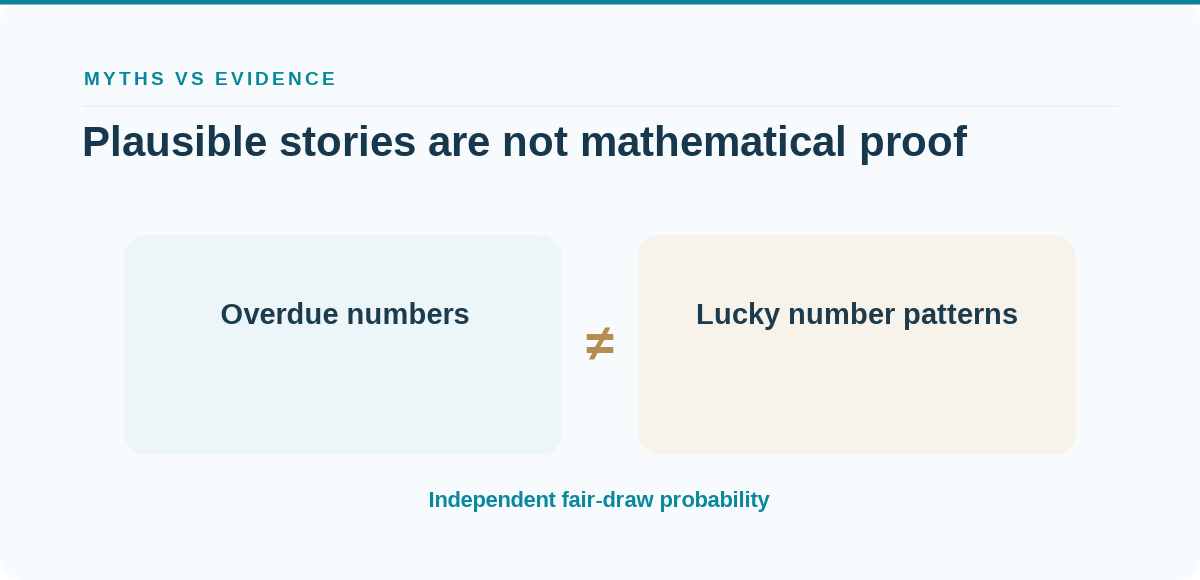
A surprising number of lottery beliefs come from one confusion: the assumption that a random process must compensate for its previous results to remain fair.
If one number has appeared frequently, people say it must cool down. If it has been absent, they say it must catch up. If a particular line won, they assume it cannot win again. These are different versions of assigning memory to an independent draw.
Fairness operates through the rules and probability distribution of each event, not through a promise that every short run of results will look evenly balanced.
When you see a claim about a “due” result, try rewriting it as a precise probability statement. If the argument relies only on past frequency, it has probably confused a historical observation with a future prediction.
One myth-checking habit
When somebody offers a selection rule, translate it into a testable claim. “This pattern feels lucky” is a personal preference. “This pattern wins more often” is a statistical claim that requires prospective evidence against a fair baseline. Separating the two prevents enjoyable traditions from being repackaged as guaranteed strategies.
Why these myths keep returning
Humans are pattern-finders. We prefer a story where somebody can influence a result to one where the result is determined by chance. Marketing can exploit that preference by attaching scientific-looking words to ordinary selection tools.
For a clear starting point, LottoLuma's FAQ, lottery odds calculator and methods page explain how numbers are selected and why selection does not predict a fair draw.
The most useful habit is not memorising more “winning systems”. It is identifying the exact claim a system makes and asking what evidence could genuinely support it.
Sources and further reading
- Powerball — April 2024 Quick Pick and winner explanation
- MDN Web Docs — Crypto.getRandomValues()
- LottoLuma — FAQ and number selection methods
Reference links support the article's factual and technical framework. Verify the current game version and editorial wording again before publication.