



A lottery syndicate can begin with an innocent conversation: “Shall we all put a little in and choose some numbers together?” The mathematical part is straightforward. The practical part — deciding exactly who owns what — deserves much more care.
A syndicate pools contributions and may cover more ticket combinations, but it does not make any individual combination more likely to win. Any prize division depends on the agreed shares and the lottery's rules.
What changes when people join together?
Imagine five friends contribute to a shared group and decide to purchase a small, fixed set of entries. The group may be able to hold more distinct combinations than one participant would have chosen alone for the same personal contribution.
If the group wins, however, the proceeds are shared according to its agreement. More group entries do not create a secret mathematical edge; they change how costs, entries and potential prizes are pooled.

Agree the important details before the draw
Who belongs to the group? What does each person contribute? Which draws and games are covered? Who selects the numbers, buys tickets and checks results? How are winnings divided? What happens if somebody misses a payment or joins late?
These questions are less glamorous than choosing a lucky line, but they can become crucial if a significant prize is involved. A simple written agreement made in advance is much easier to interpret than several conflicting memories afterwards.
The Irish National Lottery offers syndicate guidance and an agreement template. Always check the current rules and legal position relevant to your own country and game.
Decide how numbers will be selected
Groups can choose manually, use Quick Pick or prepare valid combinations with an independent number generator. They might allow each member to suggest one line or nominate one person to organise the batch.
Whatever method they choose, a fair draw does not favour group-selected numbers over individual ones. It is sensible to detect accidental duplicate combinations within the group if the objective is broader coverage, although duplicate tickets can have game-specific prize implications.
How a syndicate should handle a disagreement before it happens
A group's written agreement can describe how decisions are made when members disagree about numbers or which draws to enter. It can also define whether somebody is allowed to withdraw and how to handle unused contributions.
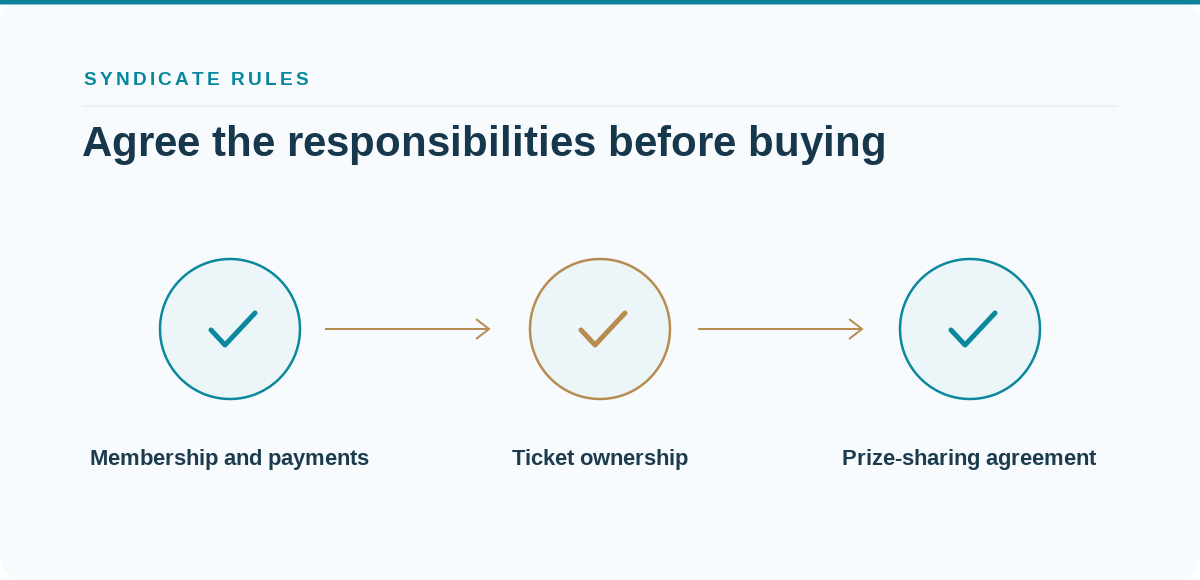
These sound like administrative details, but they affect trust within the group. A group that cannot agree on ownership and responsibilities before any prize exists is unlikely to find the matter easier after an unexpected jackpot.
A responsible organiser should keep records accessible to the members, protect ticket information and direct official claim questions to the lottery operator.
No agreement can improve the winning probability of a line. Its value lies in making the consequences of a shared activity clear to everyone involved.
Keep purchase evidence separate from generated lines
A spreadsheet of proposed numbers is not proof that tickets were purchased. The organiser should retain the official ticket records, dates, agreed contributions and relevant communications securely. Other members should know how to verify the group's entries.
Avoid exposing ticket images or personal details in public chats. If a significant dispute arises, applicable law and the operator's rules will matter.
One example of how shares can become confusing
Suppose four people agree to contribute equally to a group of official tickets. Three pay before the draw and one promises to pay tomorrow. Does the unpaid person already own a quarter share if the group wins tonight?
There is no universal informal answer. That is why the group's agreement needs to define when membership and entitlement begin, how late payments work and whether a person can opt out of a particular draw.
The group should also specify who retains the tickets, how copies are distributed securely and who communicates with the operator if a claim is necessary.
These questions are not attempts to make a lottery less random. They are ordinary safeguards against a shared activity becoming a dispute.
A syndicate should be organised so everyone can enjoy it within an agreed affordable budget, regardless of whether the numbers ever win.
The agreement question that matters most
Imagine four friends agree to buy tickets together, but one has not contributed before the draw. Does that person own a share if the group wins that night? There is no universal informal answer. A written agreement should set clear entry, payment, withdrawal and prize-sharing rules *before* tickets are purchased, with official records available to the members.
Keep the group enjoyable
A syndicate works best when members see it as a social activity with a predetermined affordable contribution, not as a scheme to generate dependable earnings. Nobody should feel pressured to contribute more after a losing draw.
Use LottoLuma's game directory to understand the formats and its general generator to prepare example selections. Use the official operator for valid ticket purchase and results verification.
Sharing the numbers is the easy part. Sharing expectations clearly is what makes a syndicate manageable.
Sources and further reading
- Irish National Lottery — syndicate guidance
- LottoLuma — safer lottery participation
- LottoLuma — how to use number generators
Reference links support the article's factual and technical framework. Verify the current game version and editorial wording again before publication.