



Yes, and that answer needs a second sentence immediately: using previous winning numbers does not mean predicting future winning numbers. A generator can incorporate past results in many legitimate ways, from avoiding a combination you have already seen to weighting numbers according to historical appearance. None of those options creates information about an independent future draw.
Three things “based on history” might mean
The phrase sounds straightforward until you inspect it. One website might mean it chooses the historically most frequent numbers. Another might avoid combinations that appeared before. A third may offer an ordinary random generator alongside a graph of past results, without the graph affecting selection at all.
Those are three different products. Before trusting the output, ask the tool to specify what the history actually changes: the pool of permitted combinations, the weights assigned to numbers, or simply the information shown beside the generated line.

The historical data can be the weak link
A well-written algorithm cannot repair invented or mismatched source data. Lottery history files sometimes mix number orders, include bonus balls among the main numbers, omit dates, repeat draws or fail to reflect rule changes.
Suppose a spreadsheet contains a six-number result in one row and seven values in the next because a bonus ball was included. An uncritical analyser may distort its frequency counts. The error can then travel into every generated selection, creating a glossy output based on poor input.
Check that each row belongs to the specified game, follows the format in effect at the time and has a verifiable draw date. Keep the original source link wherever possible.
Why exact historical combinations aren't a useful exclusion list
A person may argue that once a six-number combination has won, there is no reason to select it again. But if the future draw is independent and fair, the combination has exactly the same chance as it would have had without that history.
There are so many possible combinations in major lotteries that exact repeats may be rare in a finite archive. Their rarity does not give previously seen lines a special mathematical status. Avoiding them is a user-defined restriction.
A history-based generator should not mistake “rare in the archive” for “more likely next time”. Nor should it compare unordered combinations as text strings without normalising their number order. The same six numbers written backwards are not a novel result.
The educational benefit of history is often the question it prompts: why does something that happened feel less likely to happen again, when the draw's rules have not changed? That is a more interesting lesson than a list of supposedly exhausted numbers.
Does repeating an old winning combination hurt your chances?
No. In a fair independent draw, a six-number combination that won several years ago has the same chance as any other valid six-number combination next time. Excluding every historically winning line is a personal filter, not a mathematical improvement.
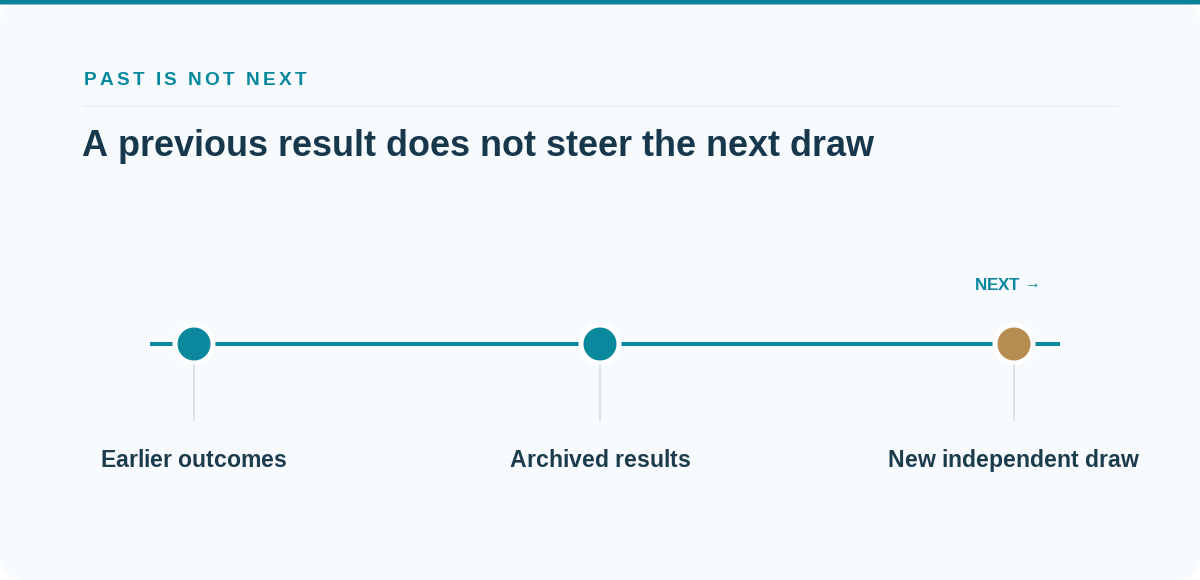
There is a psychological appeal to excluding it: people tend to think a previously winning combination has exhausted its luck. But a random process has no memory of the ticket's history.
What a transparent history-weighted mode should disclose
A well-documented tool should explain the period it studies, whether frequencies are calculated by ball or full combination, and exactly how those frequencies affect the output. It might, for example, give historically frequent numbers greater selection weight. That is a meaningful software behaviour, but it should not be described as a statistically proven advantage.
If a generator instead excludes previously winning combinations, it should state that it deliberately removes some still-valid results. If the operator changed the game format during the chosen history period, the tool should explain whether it normalises or separates the records.
A reader should also be able to switch back to unrestricted randomness. That makes it possible to compare selection methods without the interface quietly treating the history-based mode as inherently superior.
The clearest disclosure would say something like: “This mode changes how the website selects numbers using verified historical data. It does not change the official draw's probabilities.” That is the difference between an interesting educational feature and an unsupported prediction claim.
The future-result test
Suppose you have 200 historical draws. Use the first 150 to build your number-ranking method, then freeze the method and examine its choices on the next 50. Do not adjust the rule after looking at those final results. Even then, a short run can be noisy; comparison with a random baseline and larger genuinely unseen samples is essential before claiming predictive value.
A simple experiment to reveal the difference
Generate 100 lines with an unrestricted random mode. Then create 100 lines using a historical-frequency weighting method. Compare the proportion of high-frequency numbers in the two sets. You may find that the weighted method deliberately picks those numbers more often — precisely as designed.
What you have measured is the difference between two selection algorithms. You have not shown that the weighted lines are more likely to win. To establish predictive performance you would need properly held-out future draws and a valid random baseline, a much harder proposition.
For historical research, start with LottoLuma's draw-history file guide and its explanation of selection methods. The site provides number-selection and analysis tools, not a guarantee of future results.
History can make lottery numbers more interesting. It cannot make a fair machine remember which ones you would like next.
Sources and further reading
Reference links support the article's factual and technical framework. Verify the current game version and editorial wording again before publication.