



Machine learning is extraordinarily good at discovering regularities in complicated data. So why shouldn't it uncover a profitable pattern in lottery results? The answer is that a model cannot extract a reliable forecast from a process that supplies no predictive signal, however sophisticated the model becomes.
First establish what is being predicted
A model might try to predict a particular ball, the full combination, the number of odd balls or whether a draw contains a consecutive pair. Those are distinct targets with different probabilities.
A classifier that predicts “at least one even number” correctly most of the time may be accomplishing very little because that event is common under ordinary chance. The evaluation needs the appropriate baseline, not a vague success percentage.
Why a model can look smart on old draws
Suppose you provide thousands of historical draws to a machine-learning algorithm. You allow it to test hundreds of candidate features, alter parameters repeatedly and choose whichever version scores best on that same dataset.
The final model may appear to discover an extraordinary relationship. But it has had numerous opportunities to fit random quirks. This is called overfitting, and it is particularly dangerous when the true process is independent and random.
Even a carefully split historical dataset is not enough if researchers continue modifying the method after examining the supposedly held-out test results.
What a credible evaluation looks like
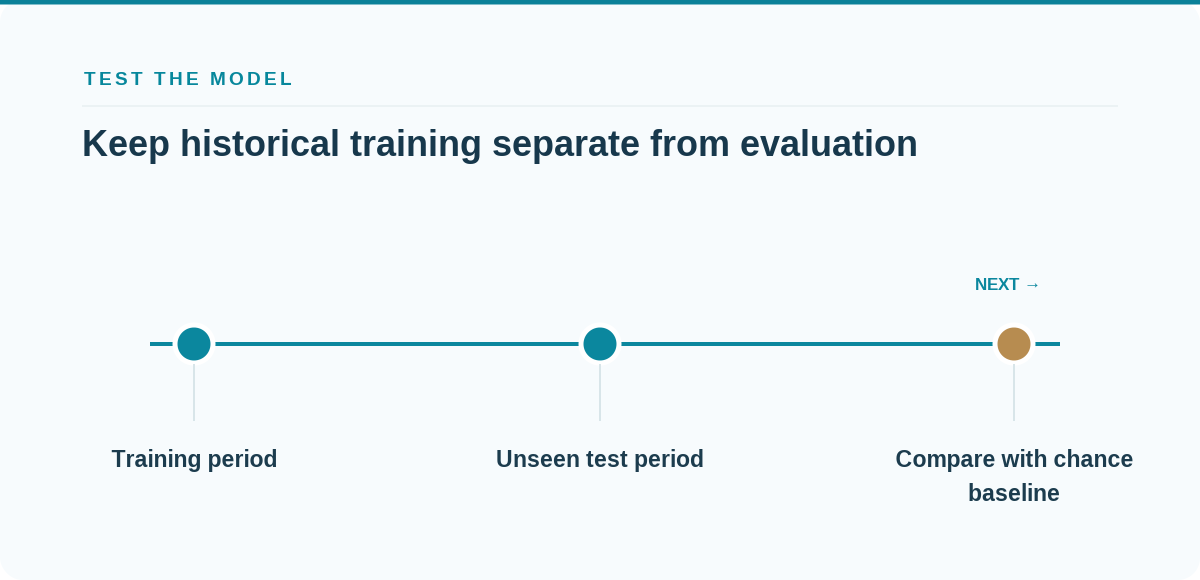
Choose a game and freeze its rules. Define a scoring event such as the exact full combination, a specific prize-tier match or an agreed per-number metric. Fix the algorithm before the test period begins.
Then record predictions for future draws, including every failure, and compare them with an equally sized selection of appropriately generated random lines. Report sample size, statistical uncertainty, rule changes and the evaluation code.
The rarer the claimed event, the more data may be necessary. A system that has not predicted any jackpots cannot prove a jackpot edge merely by scoring minor partial matches.
The problem of changing game formats during model training
Suppose an algorithm studies a lottery across a period when the number pool changed. If the model does not account for that change, it may incorrectly interpret a number's absence in the earlier period as a statistical pattern.
A simple example would be trying to learn the appearance rate of a number that was not even eligible in all historical years. No amount of model sophistication can make that input definition sensible.
Careful machine-learning research therefore begins with the rules and dataset: eligible values, draw frequency, special pools and the exact meaning of each recorded result.
This is another reason to treat a verified history file as a foundation for analysis, not as a magical training ingredient. Garbage data can produce polished graphs just as easily as sound data can.
A model can still be useful without forecasting
Historical results are interesting material for teaching statistics. Machine learning may cluster different selection styles, detect mistakes in a data import, or demonstrate the effect of data leakage. An anomaly-detection method could help flag results that deserve human scrutiny, although a flagged result is not evidence of fraud by itself.
These are analytical tasks. They shouldn't be presented as confirmed winning-number predictions.
An elegant way for machine learning to fail honestly
Imagine building a model on ten years of past results, then freezing its code and asking it to score a year's worth of entirely future draws. Alongside it, you generate random selections under the same rules and evaluate both with the same predeclared metric.
If the model produces roughly chance-level results, that is not a technical embarrassment. It is what you would expect when the historical data contains no exploitable information about independent outcomes.
A responsible write-up would publish the negative result, the sample size and the uncertainty. A less responsible advertisement might switch to a more flattering metric after seeing the outcome or showcase the best of many attempted models.
The practical lesson is broader than lotteries: powerful algorithms can find patterns even where those patterns have no forecasting value. Scientific care lies in asking whether the pattern survives contact with fresh evidence.
Why a time-based test is essential
Lottery histories are sequences in time. A model evaluated on randomly shuffled past rows may accidentally learn from information that would not have existed when its prediction was supposedly made. A fair test uses only earlier draws to train, holds later draws aside and compares results with an appropriate random baseline. Strong-looking past-fit charts are not evidence of reliable future forecasting.
What does an honest result look like?
Sometimes the correct conclusion is that a complicated model did not beat a simple baseline. That is a valuable finding. It helps readers avoid spending money on unsupported claims.
Explore LottoLuma's draw-history guide and lottery odds calculator to separate observed history from theoretical chances.
A sophisticated model deserves admiration for what it demonstrably does — not for predicting an independent random result it has no demonstrated way to know.
Sources and further reading
- NIST — random bit generation standards
- LottoLuma — draw-history file guide
- LottoLuma — probability explorer
Reference links support the article's factual and technical framework. Verify the current game version and editorial wording again before publication.