



If a number has not appeared for months, it can begin to feel like an overdue bus. Surely it has to arrive eventually. That instinct is perfectly human — and exactly what makes hot-and-cold lottery charts so easy to misunderstand.
In a fair independent draw, a number that has been absent for a long time is not automatically more likely to appear next. It does not receive a mathematical apology for its absence.
What the labels really describe
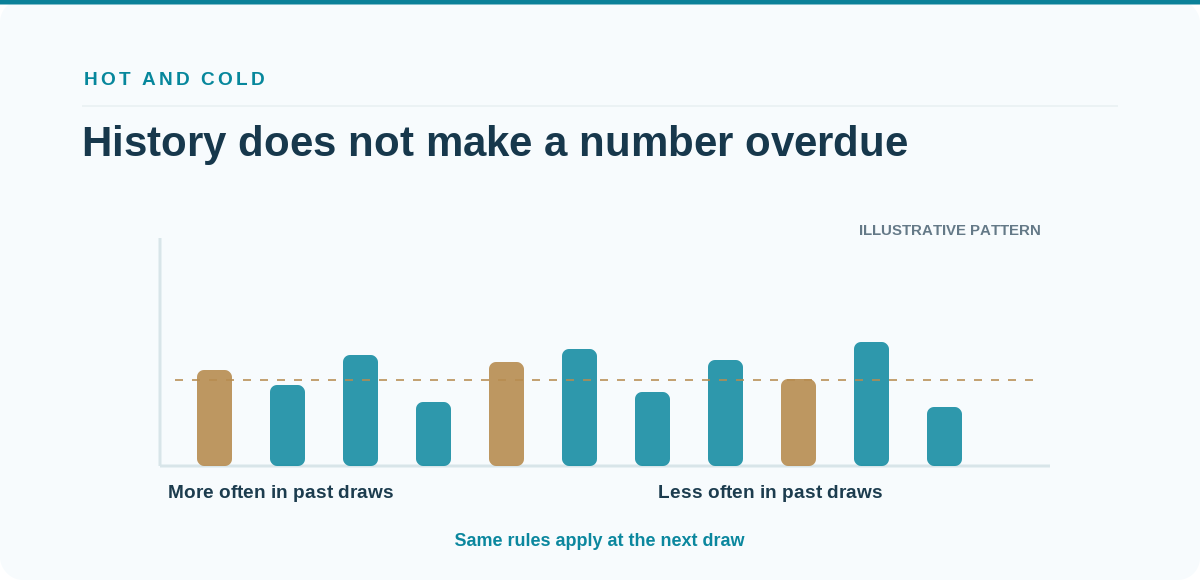
A hot number appeared relatively often in a chosen historical period. A cold number appeared relatively infrequently. Both labels require a specified window: ten draws, 100 draws or several years may tell quite different stories.
A number can be hot in one chart and cold in another without either chart being wrong. The chart is a summary of its chosen dataset. It is not a permanent rating attached to the ball.
Why “due” feels so persuasive
Imagine flipping a fair coin five times and getting heads on every flip. Many people instinctively expect tails next. But if the sixth flip is independent, tails remains a one-in-two event.
Lottery balls raise the same reasoning problem, although selection is usually made without replacement within each draw. What matters for a hot/cold argument is the relationship between different independent draws. Yesterday's result does not force tomorrow's result to compensate.
This mistaken expectation is commonly called the gambler's fallacy.
Could a real problem create uneven results?
In principle, an unfair machine, damaged ball or flawed software could bias outcomes. That is why official lottery operators use procedures intended to protect draw integrity. However, a run of unusual numbers is not sufficient evidence of mechanical or technical failure.
A credible investigation would need a defined hypothesis, an appropriate statistical method, the complete relevant data, checks for game-rule changes and consideration of ordinary random fluctuation. Calling a number “hot” is not such an investigation.
Do hot and cold labels predict the size of a future prize?
No. Even if a historically frequent number happens to appear in the next draw, that alone tells you nothing about whether a particular ticket will meet the rules for a jackpot or lower prize.
A complete prize-winning event often requires several numbers, sometimes from different pools. Looking only at the history of one ball ignores most of the selection problem.
There is another trap: counting a number as hot across an entire game's history without adjusting for changes in how many numbers were drawn. If the format evolves, the expected frequency may change with it. A trend calculated from an incompatible mixture of periods can look persuasive while measuring different events.
Treat hot/cold tables as a way to explore variation, not as instructions for the next purchase.
How to read frequency charts responsibly
Start with the source and period. Confirm that the archive contains real draws and has not accidentally included bonus balls among main balls. Then calculate the expected appearance probability under the current game rules.
For a fair six-from-59 draw, each individual number has a 6/59 chance of appearing somewhere in a round. Some numbers will appear more and others less in any finite sample. The question is whether the variation is genuinely surprising under the model, not whether one colour bar is taller than another.
LottoLuma's draw-history guide and lottery probability tool can help make the distinction between observed results and expected probabilities clearer.
Why even “extreme” results don't prove a number is due
Suppose a fair coin has shown heads eight times in a row. The probability of observing that particular eight-flip sequence is one in 256. After it happens, though, the probability of heads on the ninth independent flip remains one in two.
The difference is between the probability of a specific sequence before it occurs and the probability of the next event after a sequence has already occurred. People often switch between the two without noticing.
A fair lottery adds complexity because several numbers are selected without replacement within each draw, but the principle across independent draw events is the same: previous absence does not create a repayment obligation.
If an operator changes the machine, draw rules or ball pool, it may be appropriate to investigate the new model separately. That is a question about actual conditions of the draw, not the superstition that a number should finally have its turn.
The missing-number thought experiment
Imagine an independent fair draw in which a ball has not appeared for 30 rounds. On round 31 it still has the same chance of appearing as any other eligible ball. The past streak is part of the historical record; it is not a debt the draw owes. A useful hot-and-cold chart shows a time window and the underlying sample size rather than suggesting the next result is due.
So should you choose hot numbers or cold ones?
Neither approach offers a demonstrated predictive advantage for an independent fair draw. If you enjoy a certain selection ritual, keep it firmly labelled as a preference. Do not spend more because an overdue number seems certain to appear.
Lottery history can be entertaining. It becomes misleading only when a retrospective label is sold as a forecast.
Sources and further reading
Reference links support the article's factual and technical framework. Verify the current game version and editorial wording again before publication.